
April 2, 2026
Belief systems have traditionally been treated as passive—formed through experience, culture, and social context. But in a world shaped by algorithmic feeds, synthetic media, and microtargeted narratives, passivity is a liability. Disinformation is no longer incidental; it is engineered.
What if, instead, your belief system had an active counterpart—a dynamic, AI-powered digital twin that continuously models, tests, and defends your perception of reality?
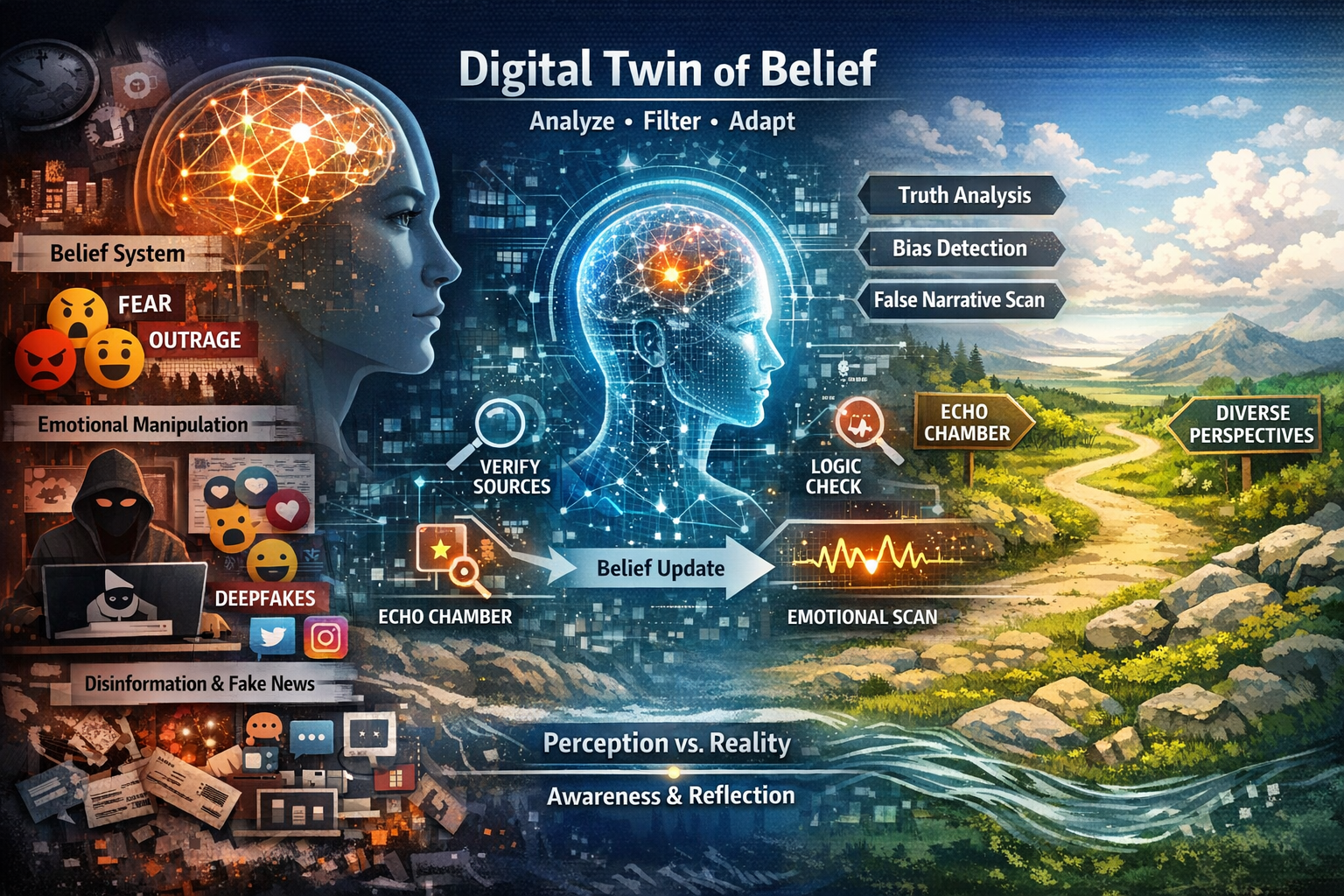
This article explores a new paradigm: the digital twin of a belief system—a computational mirror of your attitudes, values, and cognitive tendencies that acts as a filter, simulator, and validator for incoming information.
The Mirror in the Mind: A Story of Belief, Machines, and the Fight for Reality
It starts quietly.
Not with a lie, but with something that feels true.
A headline scrolls past. A video plays. A post—shared by someone familiar—lands with just enough plausibility to slip past your guard. You don’t stop to verify it. You don’t need to. It fits. It aligns. It resonates.
And in that moment, something subtle happens: your belief system shifts—not dramatically, not visibly, but just enough.
Now imagine if something were watching that shift.
A Second Mind
Somewhere alongside your thoughts, there exists a parallel structure—a digital twin of your belief system. It doesn’t think for you. It doesn’t replace you. Instead, it observes, models, and simulates the way you believe.
It knows which ideas are central to who you are and which ones you barely care about. It understands that some beliefs are reinforced by your identity, your community, your history—while others are loosely held, waiting to be reshaped.
This twin isn’t static. It evolves with you. Every article you read, every conversation you have, every emotional reaction you experience—it updates its internal map.
But unlike you, it never forgets how a belief formed.
The Anatomy of Belief
In this twin’s world, beliefs are not simple yes-or-no statements. They are living structures.
Each belief has weight—how strongly you hold it. It has connections—how it links to other beliefs. It has emotional charge—how much it matters to you. And perhaps most importantly, it has a history: where it came from, how often it’s been reinforced, and by whom.
Some beliefs sit at the center of your identity. These are the ones that define you—your values, your worldview, your sense of belonging. Others orbit at the edges, flexible and open to change.
The twin sees all of this. It understands that changing one belief can ripple through the entire system, creating tension, contradiction, or alignment.
And it knows something else: not all changes are organic.
The Intrusion
Disinformation doesn’t knock on the door. It walks in disguised.
It borrows the voice of trusted sources. It mimics the tone of truth. It leverages emotion—fear, outrage, validation—because emotion bypasses scrutiny.
Most of all, it repeats.
The same idea, again and again, from slightly different angles, until it becomes familiar. And familiarity, as it turns out, feels a lot like truth.
Your brain, efficient and adaptive, uses shortcuts. If something is easy to process, if it fits your identity, if it seems widely accepted—you’re more likely to accept it.
The twin sees this happening in real time.
It notices when a claim feels true before it’s been verified. It detects when repetition is doing the work that evidence should. It flags when an idea aligns a little too perfectly with your biases.
Where you feel certainty, it sees patterns.
The Filter
Now the twin begins to act—not by blocking information outright, but by filtering it through layers of scrutiny.
A new piece of information arrives.
First, it asks: Is this real?
It examines the structure of the content—looking for signs of manipulation, synthetic generation, or altered context.
Then: Does this make sense?
It compares the claim against your existing beliefs, checking for coherence, contradiction, and logical consistency.
Next: Who else believes this—and why?
It reaches outward, consulting external validators—fact-checkers, alternative sources, competing narratives. If they disagree, it digs deeper, questioning not just the claim, but the credibility of those validating it.
Then comes a quieter, more subtle question: How is this trying to make you feel?
Because emotion is often the real payload.
Is the message designed to provoke anger? Fear? Tribal loyalty? Does it feel tailored—almost too precisely—to your concerns, your identity, your vulnerabilities?
If the twin detects manipulation, it doesn’t panic. It isolates the information, holding it in a kind of cognitive quarantine.
If the information passes these tests, it is allowed through—but not uncritically. Instead, it updates your belief system gradually, adjusting weights, recalibrating confidence.
And it remembers the source.
The Shifting Ground
Over time, the twin begins to notice something else: not just what you believe, but how those beliefs are changing.
Some remain solidly anchored, deeply resistant to new evidence. These are your entrenched beliefs, often tied to identity and reinforced by your social environment.
Others begin to wobble.
A belief that once felt certain now carries a hint of doubt. Conflicting information has weakened its connections. Its emotional charge has faded.
The twin marks it as changeable.
This is where belief transformation happens—not in moments of dramatic revelation, but in slow, cumulative adjustments.
But it also knows the danger here.
Because once a false belief takes hold, even correcting it doesn’t fully erase it. The original idea lingers, influencing reasoning in subtle ways. Sometimes, even after correction, beliefs drift back toward their original state.
The twin watches for this regression. It reinforces corrections, tracks inconsistencies, and resists the quiet pull of familiarity.
The Neighborhood You Didn’t See
You like to think your beliefs are your own.
But the twin sees the environment shaping them—the invisible “neighborhood” of information you inhabit.
It’s not just your physical surroundings. It’s your feeds, your networks, your algorithms. It’s what you see repeatedly and what you never see at all.
In one environment—say, a college campus—you are exposed to diverse ideas, challenged, reshaped. In another—an online echo chamber—you are reinforced, validated, and insulated.
The twin maps this landscape.
It detects when your inputs lack diversity. When certain narratives dominate. When artificial amplification makes minority views appear widespread.
It doesn’t force change—but it introduces friction. It encourages exposure to alternative perspectives, not to destabilize you, but to ensure your beliefs are grounded in something broader than repetition.
The Cost of Defense
But this system is not perfect.
A digital twin can protect—but it can also entrench. If it overweights your existing beliefs, it may reject valid challenges. If it relies too heavily on flawed “truth sources,” it may inherit their biases.
Worse, if someone learns how your twin works, they could design information to slip past it—disinformation tailored not just to you, but to your defenses.
And there is a deeper risk: that in filtering too aggressively, you lose something essential—the ability to be surprised, to change, to grow.
Because belief is not just about defense. It is also about openness.
The Mirror
In the end, the digital twin is not a shield. It is a mirror.
It shows you not just what you believe, but why. Not just what feels true, but what has been made to feel true.
It reveals the forces acting on your perception—the subtle pressures of repetition, identity, emotion, and social influence.
And in doing so, it gives you something rare:
Not certainty.
But awareness.
In a world where reality is increasingly contested, that awareness may be the most valuable defense we have—not a system that tells us what to think, but one that helps us understand how we come to believe at all.
I believe digital twins will come to play a larger role in our daily lives for improving our awareness and as a way to combat disinformation. Let me know of any emerging ways you know about to combat disinformation as well as your views on this topic. And thanks to my subscribers and visitors to my site for checking out ActiveCyber.net! Please give us your feedback because we’d love to know some topics you’d like to hear about in the area of active cyber defenses, artificial intelligence, authenticity, quantum cryptography, risk assessment and modeling, autonomous security, digital forensics, securing OT / IIoT and IoT systems, Augmented Reality, or other emerging technology topics. Also, email chrisdaly@activecyber.net if you’re interested in interviewing or advertising with us at Active Cyber™.



