
January 27, 2026
We have all been bombarded over the last few years about the race to Artificial General Intelligence (AGI) and super AGI and how it is a race that must be won. It was reported recently that the timeline to AGI is tightening, and according to Anthropic CEO Dario Amodei, the window for policymakers to prepare is closing faster than many realize. I have been debating in my mind for a while whether this AI race will prove to be a benefit or a detriment to humankind. I attended a recent cyber forum where I posed that question to a policymaker from my state of Maryland. He reflected on the fact that guardrails that had been identified in a previous study have gone by the wayside to ensure that the state stayed competitive in the race. Looking at the use of AI with a cyber lens reveals that there are many negative consequences that must be dealt with as well. Although there are some cyber defenses and potential guardrails that may prove effective, it is unclear whether the leaders of the AI race and regulators of this space will adopt these and similar measures to prevent or mitigate negative consequences. So read the article below to follow some aspects of my journey into the realm of AI and cyber. I will be coming out with a companion article on a dive into AI infrastructure next.
Artificial intelligence is transforming security in a deeply dual way: it strengthens defense while simultaneously supercharging offense. Generative and agentic AI systems lower the barrier to sophisticated cyberattacks, enabling identity fraud, extortion, and large‑scale disinformation at unprecedented scale and realism. This article examines some of the negative consequences of AI, with a focus on voice and image cloning, synthetic media, training bias, and political skew in large models. It then explores emerging technical, infrastructural, and regulatory responses, including data provenance frameworks, watermarking, trusted platform technologies, confidential computing, and zero trust to ensure the integrity of AI systems and the data that powers them.
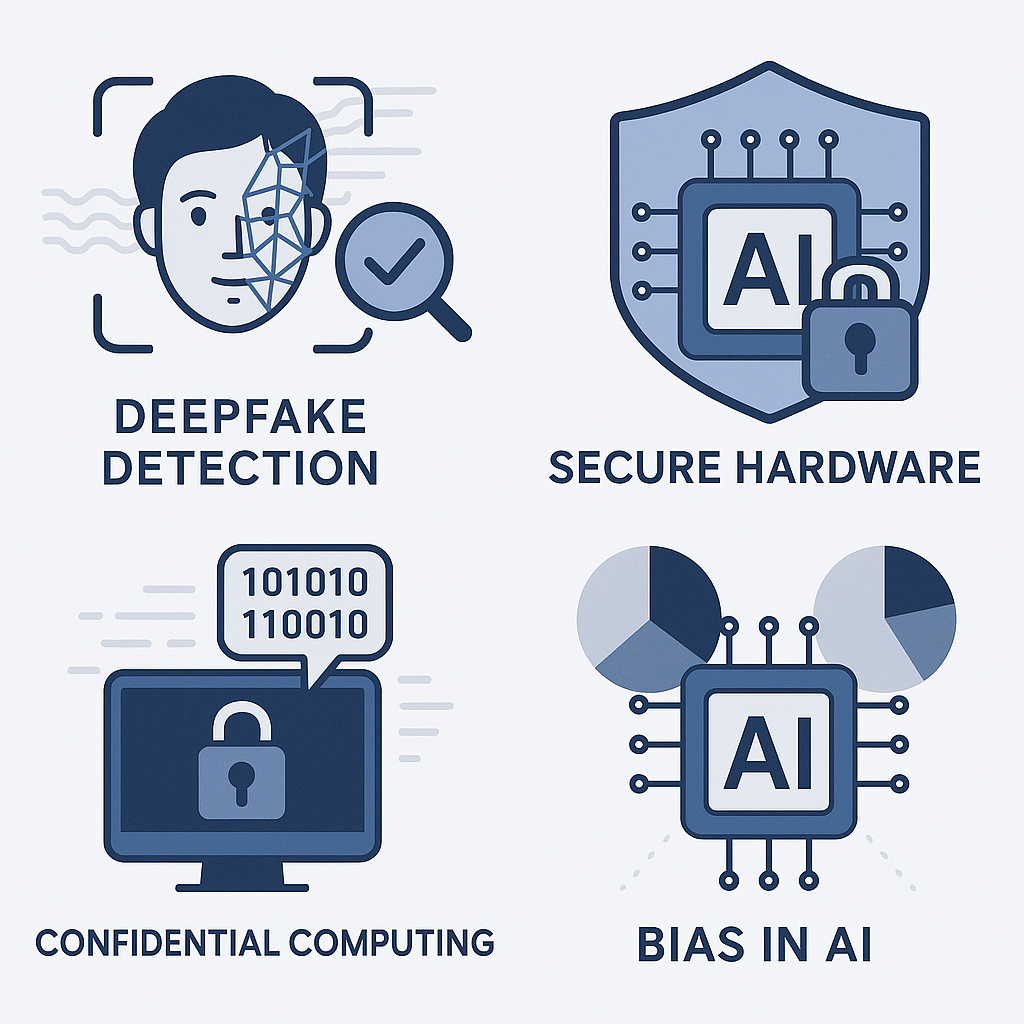
AI – A Two-Edged Sword
AI has moved from being a tool used by security teams to a core substrate of the digital environment itself. Large language models, multimodal generators, and autonomous agents are now embedded in communication platforms, productivity tools, financial systems, and critical infrastructure. This ubiquity creates a new class of systemic risk: when the same technologies that power productivity and automation are repurposed for deception, coercion, and manipulation. Adversaries now leverage AI to generate synthetic identities, craft persuasive phishing content, manipulate public discourse, and bypass biometric authentication systems. These developments have prompted researchers and policymakers to reassess the security assumptions underlying digital identity, information integrity, and data provenance.
The central question is no longer whether AI will affect cybersecurity, but how deeply it will reshape the assumptions we make about identity, authenticity, and trust online.
AI-Enabled Hyper‑Realistic Impersonation
Generative AI enables attackers to convincingly mimic individuals’ voices, faces, and writing styles with minimal input data. Voice‑cloning systems can now synthesize speech from just a few seconds of audio, while deepfake video models can animate still images or reenact facial expressions in real time.
This enables:
- Executive impersonation and financial fraud: cloned voices used to authorize wire transfers or approve sensitive actions.
- Synthetic identity construction: blending real and fabricated attributes to bypass KYC and identity verification, now the fastest growing financial crime in US.
- Credential harvesting: deepfake video calls or audio messages used to trick employees into revealing passwords or MFA codes.
The result is a collapse of traditional “human intuition” as a security control—people can no longer reliably trust what they see and hear.
AI‑Enhanced Extortion
Extortion has also become more scalable and psychologically invasive using AI:
- Deepfake (or “CheapFake”) blackmail: fabricated explicit images or videos are used to coerce victims.
- Automated, personalized threats: language models generate tailored phishing emails or extortion messages at scale.
- Synthetic hostage and distress scams: cloned videos of loved ones are used to simulate distress and demand urgent payments.
These attacks exploit emotional urgency and the difficulty of quickly verifying authenticity of audiovisual evidence under stress.
Automated Influence Operations
AI systems can generate persuasive, context‑aware political and social content in any style or tone. This enables:
- Mass production of propaganda tailored to specific demographics.
- Impersonation of public figures.
- Creation of fake experts, influencers, or grassroots movements.
- Real‑time adaptation of narratives based on engagement signals.
Research from OpenAI and Georgetown University demonstrates that AI-generated propaganda is indistinguishable from human-written content for most readers. AI can therefore reduce the cost of running a sophisticated influence operation dramatically, while also increasing the scale and granularity of an influence campaign.
Synthetic Media and the Erosion of Evidence
Deepfakes and synthetic imagery undermine the epistemic foundations of digital societies:
- Fabricated events can be made to appear real, complete with “supporting” images, videos, and documents.
- Authentic evidence can be dismissed as fake—the so‑called “liar’s dividend,” where the mere existence of deepfakes allows wrongdoers to deny reality.
This erodes trust in journalism, legal processes, public institutions, and democratic processes while complicating attribution in security incidents.
Voice and Image Cloning: Threats and Defenses
Voice and image cloning technologies have matured rapidly due to advances in diffusion models and neural audio synthesis, thereby introducing several concrete risks:
- Bypassing biometric authentication: voice ID and facial recognition systems can be fooled by high‑quality synthetic samples.
- Financial and operational fraud: voice‑based approvals, call‑center authentication, and remote identity checks become vulnerable.
- Reputational harm and harassment: non‑consensual explicit deepfakes which disproportionately target women; and, fabricated public statements.
- Political destabilization: fake speeches, announcements, or crisis communications attributed to leaders.
These attacks are particularly dangerous because they exploit channels—voice and video—that people have historically treated as strong evidence.
Research and industry efforts are converging around several defensive strategies:
- Liveness detection: analyzing micro‑expressions, eye movements, head pose, and acoustic cues to distinguish live humans from synthetic media.
- Deepfake detection models: classifiers trained on large corpora of synthetic and real media to identify artifacts or inconsistencies.
- Watermarking and content credentials: embedding cryptographic signatures or invisible marks into authentic media at capture time.
- Anomaly detection for voice patterns: monitoring for unusual acoustic or behavioral patterns in high‑risk workflows (e.g., executive approvals).
These defensive strategies are centered on establishing the authenticity of the information channel by assessing the integrity of the signals being presented. These approaches are necessary but not sufficient; as generative models improve, forensic signals diminish and detection becomes a moving target. Knowing the provenance of the identity or data can assist in establishing the signal authenticity.
Data Provenance, Training Bias, and Synthetic Consensus
Ensuring data provenance is not only about verifying the origin of training data—it is also about understanding the ideological, cultural, and demographic biases embedded within that data. Because large AI models learn statistical patterns from massive corpora scraped from the web, licensed from providers, or generated synthetically, any systematic skew in those corpora can produce outputs that appear to reflect broad social consensus, even when the underlying population holds diverse or opposing views. This phenomenon—sometimes described as synthetic consensus formation—poses significant risks for public discourse, political neutrality, and epistemic trust.
How Biased Training Data Creates the Illusion of Consensus
Recent research demonstrates that political and ideological biases in training corpora directly shape model outputs. Specifically, the research shows that large language models’ political leanings correlate strongly with the political distribution of their pretraining data, often more so than with human survey responses. Their study finds that models tend to reproduce the dominant ideological patterns present in the text they ingest, meaning that if the training data overrepresents certain viewpoints, the model will amplify those viewpoints as if they were widely shared.
This creates two systemic risks:
- False Consensus Effect: When a model repeatedly generates similar ideological positions, users may interpret this as evidence of broad societal agreement—even if the real population is polarized or holds contrary views.
- Epistemic Homogenization: Because many AI systems are trained on overlapping datasets, they may converge on similar ideological outputs, reinforcing the appearance of a unified “AI consensus.”
Multiple independent studies have found that large general‑purpose AI systems tend to exhibit left‑leaning political tendencies, particularly on social and cultural issues.
- Faulborn et al. (2025): Using a theory‑grounded measurement framework, the authors find that several leading LLMs—including GPT‑4 and LLaMA variants—consistently produce responses aligned with left‑of‑center political positions across a range of prompts and evaluation methods.
- Rozado (2025): In a multi‑method analysis comparing AI‑generated text to the language of U.S. Republican and Democratic legislators, Rozado finds that major AI systems systematically align more closely with Democratic linguistic patterns and policy preferences.
- Löhr et al. (2025): A study of explicit and implicit political stereotypes across eight prominent LLMs shows consistent left‑leaning tendencies when evaluated using the Political Compass Test and stereotype‑propagation benchmarks.
Together, these studies indicate that political bias is not incidental but structural — emerging from the composition of training data, the distribution of online text, and the reinforcement learning processes used to align models with human feedback. This reinforces concerns that training bias can shape not only factual outputs but also normative and political judgments.
Mechanisms Driving Political Skew
Several mechanisms explain why large AI models may lean left‑of‑center:
- Training Data Composition – Public web data—especially from news, academia, and social media—tends to overrepresent progressive or liberal viewpoints relative to the general population. LLMs’ political leanings track these distributions closely.
- Reinforcement Learning from Human Feedback (RLHF) – Human annotators, who disproportionately come from certain demographic and ideological groups, influence model alignment. This can introduce systematic ideological drift.
- Content Moderation Policies – Safety guidelines often penalize outputs associated with right‑leaning or conservative viewpoints more heavily, unintentionally reinforcing asymmetry.
- Homogeneity of AI Research Communities – Academic and industry AI labs tend to be ideologically clustered, which may influence both dataset curation and model‑alignment decisions.
Security and Societal Risks of Synthetic Consensus
The convergence of biased training data and large‑scale deployment of AI systems creates several risks:
- Manipulation of Public Opinion – If AI systems consistently present one ideological perspective as “neutral,” they may subtly shift user beliefs.
- Erosion of Democratic Pluralism – When AI‑mediated information ecosystems homogenize viewpoints, minority or dissenting perspectives may be marginalized.
- Vulnerability to Information Warfare – Adversaries can exploit known model biases to craft targeted disinformation or manipulate model outputs.
- Regulatory Blind Spots – Current AI governance frameworks focus on safety and transparency but rarely address ideological neutrality or representational fairness.
Implications for Data Provenance and Governance
To address these identity and information model risks, data provenance frameworks need to evolve beyond simple origin tracking to include:
- Ideological provenance – Documentation of political, cultural, and demographic distributions in training corpora.
- Bias audits – Systematic evaluation of political and normative outputs across models.
- Diversity requirements – Ensuring training data reflects a balanced representation of viewpoints with clear labeling rather than homogenization.
- Transparent RLHF pipelines – Disclosure of annotator demographics and alignment criteria.
Without such measures, AI systems risk becoming engines of synthetic consensus—shaping public discourse in ways that are opaque, unaccountable, and potentially misaligned with democratic values.
Technological Responses to Provenance and Authenticity
Several software and hardware-based approaches are emerging to strengthen provenance and authenticity and overall security of AI environments. Some of the software technologies that can be leveraged:
- Cryptographic content credentials – standards that bind media to signed metadata about its origin, device, and edits. For example, the Coalition for Content Provenance and Authenticity (C2PA) provides cryptographic signatures for images, audio, and video. W3C Verifiable Credentials enable attestations for datasets and model inputs.
- Dataset and model watermarking – embedding fingerprints into training data or model weights to detect tampering or unauthorized use.
- Tamper‑evident logs – using hash chains or similar mechanisms to record data ingestion, labeling, and training steps. For example, blockchain‑based audit logs provide tamper‑evident data pipelines. By ensuring traceability of datasets, model updates, training logs, and inference outcomes, blockchain can provide regulators, stakeholders, and organizations with reliable audit trails.
- AI supply‑chain security- extending software bill‑of‑materials (SBOM) concepts to datasets, models, and pipelines.
- AI Zero trust: Zero Trust security ensures that sensitive information is always protected, regardless of where it is stored, processed, or accessed—which is why it’s critical for AI adoption. To meet these protection needs, zero trust technology needs to control access and specify identities (human and non-human agents) to all aspects of the AI pipeline and runtime. In addition, Zero-trust AI provides the guardrails needed to deploy advanced models without exposing the business to silent data leakage, supply-chain vulnerabilities or compliance failures. For example, zero trust entails comprehensive tracking that covers prompt identity, model version lineage, agent actions and dataset origin, i.e., what data, how data is configured, coded, labeled, shared, used, stored and secured. This traceability enables forensic analysis when issues arise, supports compliance reporting and provides the visibility needed to detect and respond to security incidents.
These tools aim to make it possible to answer: Where did this data come from? Who touched it? How was this model trained? How is it protected?
Trusted Platform Technologies and Confidential Computing
Trusted platform technologies and Confidential Computing are examples of hardware approaches that can assist in the protection and establishment of authenticity of models, data, and identities involved in the AI ecosystem.
Trusted Platform Modules (TPMs) provide a hardware root of trust: secure key storage, attestation of system state, and protection against certain classes of tampering. In the AI context, TPMs can:
- Ensure that models and data run only on verified hardware and software configurations.
- Protect cryptographic keys used for content credentials and provenance systems.
- Support remote attestation that a given AI service is running the expected code and model. For example, to ensure edge AI environments are uncompromised.
This helps anchor abstract AI workflows in concrete, verifiable hardware trust.
Confidential computing uses secure enclaves (e.g., Intel SGX, AMD SEV) and hardware‑backed isolation to protect data and code while in use—not just at rest or in transit. Applied to AI, it can:
- Enable secure training on sensitive datasets without exposing raw data to cloud operators.
- Protect model weights from theft or tampering through encrypted inference.
- Support privacy‑preserving federated learning and multi‑party analytics which allows multiple parties to train machine learning models collaboratively without sharing raw data.
- Reduce the risk of insider attacks and supply‑chain compromise.
Combined with provenance and watermarking, confidential computing can form part of an end‑to‑end trust architecture for AI systems.
AI‑Native Cybersecurity Threats
Beyond identity fakes and disinformation, AI also comes with some unique cyber threats:
- Backdoored models and data poisoning: small malicious perturbations in training data that cause specific triggers to produce attacker‑chosen outputs, such as degrading performance or biasing behavior.
- Autonomous offensive agents: systems that can scan, exploit, and pivot through networks at machine speed. Managing the validation and revalidation of AI agents and their interactions at scale and speed become very difficult thereby creating windows of opportunity for adversarial agents to breach AI systems. Appropriate agent security frameworks and monitoring tools are necessary to create and manage the short-lived secrets bound to the non-human identities (NHIs) that are associated with AI agents to validate their authenticity.
- Prompt injection and tool hijacking: manipulating agentic systems into executing harmful actions via crafted inputs.
These threats blur the line between traditional malware and model behavior, requiring new forms of monitoring, red‑teaming, and incident response. They obviously also can impact the integrity of model information resulting in questions about the authenticity of model outputs.
Regulators and standards bodies are also beginning to respond to the issues regarding AI model risks and authenticity:
- AI‑specific regulations that require documentation of training data, risk classification, and transparency around synthetic media. For example, The EU AI Act mandates documentation of training data and risk classification.
- Congressional oversight requiring US executive departments to report on the security of AI infrastructure and to ensure security of AI equipment pipelines such as optical transceivers.
- Risk management frameworks, such as NIST’s AI Risk Management Framework, that emphasize provenance, robustness, and accountability.
- Proposed rules for labeling AI‑generated content in political advertising and public communications. There is proposed U.S. legislation that requires labeling of synthetic media.
While still nascent, these efforts signal a shift from purely voluntary ethics to enforceable obligations.
Conclusion
AI has become a central force in cybersecurity—not just as a defensive tool, but as an amplifier of offense, deception, and manipulation.
Voice and image cloning undermine the reliability of human perception. Generative models enable scalable identity fraud, extortion, and disinformation. Training bias and political skew risk creating synthetic consensus that subtly shapes public opinion. And the opacity of data pipelines makes it difficult to trace responsibility when things go wrong.
Addressing these challenges requires more than incremental patches. It demands:
- Robust data and content provenance systems.
- Continuous auditing of bias, political skew, and representational fairness.
- Deployment of trusted hardware and confidential computing to secure models and data.
- Regulatory frameworks that treat authenticity, pluralism, and accountability as core requirements, not afterthoughts.
The deeper question beneath all of this is about trust: who—and what—do we allow to shape our sense of reality? AI is already part of that answer. The work now is to ensure it doesn’t quietly rewrite the rest of it for us.
So what do you think about the implications of AI and where we are today in our protection posture? Do you see a net positive future for cyber defenders and the overall human populace as a result of AI and the race to AGI? Let me know your views on this topic. And thanks to my subscribers and visitors to my site for checking out ActiveCyber.net! Please give us your feedback because we’d love to know some topics you’d like to hear about in the area of active cyber defenses, authenticity, quantum cryptography, risk assessment and modeling, autonomous security, digital forensics, securing OT / IIoT and IoT systems, Augmented Reality, or other emerging technology topics. Also, email chrisdaly@activecyber.net if you’re interested in interviewing or advertising with us at Active Cyber™.



