
June 12, 2026
I believe we are on the advent of a profound job revolution as the impact from AI begins to take shape. As I think about the growing list of problems attributed in some way to AI, I am reminded of Player Piano. According to Wikipedia, Player Piano is the first novel by American writer Kurt Vonnegut Jr., published in 1952. The novel depicts a dystopia of automation partly inspired by the author’s time working at General Electric, describing the negative impact technology can have on quality of life. The story takes place in a near-future society that is almost totally mechanized, eliminating the need for human laborers. The widespread mechanization creates conflict between the wealthy upper class, the engineers and managers, who keep society running, and the lower class, whose skills and purpose in society have been replaced by machines. In the world Vonnegut envisioned, work was a privilege, and, except for a privileged few who ran the system, jobs for the masses consisted of Works Progress Administration-like infrastructure repair and the military.
Does Player Piano depict the future of work in the AI Age? What will be valued in the coming Age? How will AI impact our ability to deal with uncertainty? I believe we will see significant changes in the years ahead as new values emerge, new jobs emerge, and cultures learn to adapt. Read on to learn about How the AI Age Will Redefine Trust and Work.
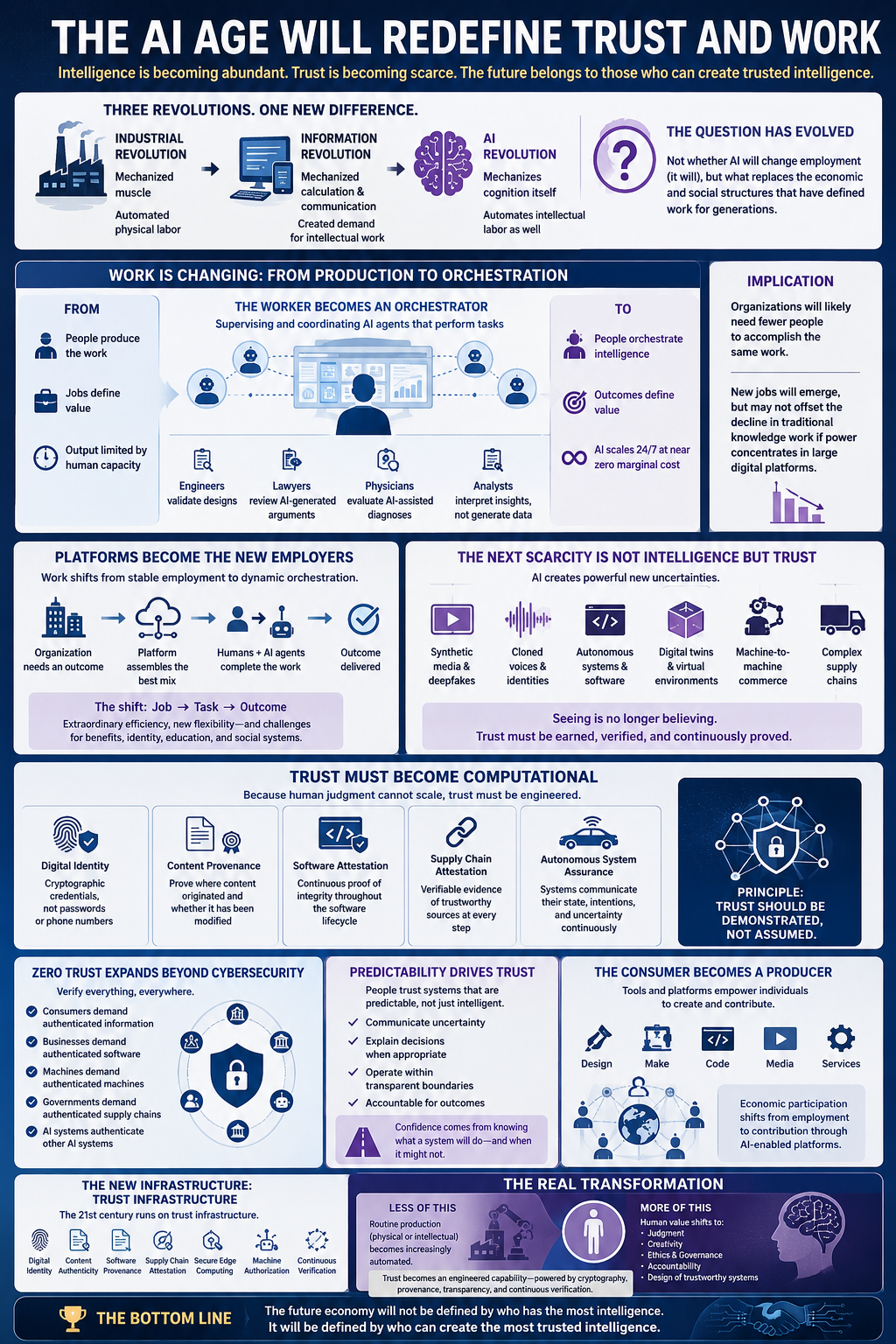
For more than two centuries, technological revolutions have changed how people work. The Industrial Revolution mechanized muscle. The Information Revolution mechanized calculation and communication. The Artificial Intelligence Revolution is different because it is mechanizing cognition itself.
Many AI advocates attempt to reassure society by pointing to history. They argue that every technological disruption has ultimately created more jobs than it destroyed. While history certainly demonstrates humanity’s ability to adapt, this comparison may overlook an important distinction. Previous revolutions largely automated physical labor while creating demand for intellectual work. AI increasingly automates intellectual labor as well.
The question is therefore no longer whether AI will change employment. It almost certainly will. The more important question is what replaces the economic and social structures that have defined work for generations. The answer may lie in two evolving concepts: trust and work.
Work Is Becoming the Management of Intelligence
For most of history, economic value was created through human effort. Factories multiplied physical productivity, while computers multiplied mental productivity. AI, however, performs reasoning, writing, coding, design, analysis, and increasingly decision support. This changes the definition of work itself.
The employee of the future may not produce a report but instead supervise dozens of AI agents that produce reports. Engineers may increasingly validate designs rather than create every component. Lawyers may review arguments generated by autonomous systems. Physicians may spend more time evaluating AI-assisted diagnoses than searching medical literature themselves. The worker becomes less a producer and more an orchestrator.
Consequently, organizations will likely require fewer people to accomplish the same amount of work. AI systems operate continuously, improve through experience, and scale at almost zero marginal cost. While new occupations will emerge, they may not offset the reduction in traditional knowledge work if economic power continues concentrating in large digital platforms.
The historical assumption that displaced workers naturally migrate into new industries may become increasingly difficult when intelligence itself becomes abundant.
Platforms Become the New Employers
Digital platforms have already transformed markets by matching buyers and sellers, drivers and passengers, creators and audiences, and employers and contractors. AI accelerates this trend. Rather than hiring employees to perform tasks, organizations may increasingly contract with platforms that dynamically assemble teams of humans and AI systems. The unit of economic activity shifts from the job to the task, and eventually from the task to the outcome.
Employment relationships may therefore evolve into orchestration relationships. This creates extraordinary efficiencies while simultaneously challenging many of the social institutions built around stable employment, including benefits, professional identity, education, and retirement systems.
The Next Scarcity Is Not Intelligence but Trust
Ironically, as intelligence becomes inexpensive, trust becomes expensive. Every technological advance described today—from deepfakes and synthetic media to autonomous vehicles, digital twins, metaverse environments, and machine-to-machine commerce—creates uncertainty about authenticity.
- Can we trust what we see?
- Can we trust who we are communicating with?
- Can we trust the software executing our transactions?
- Can we trust the AI model making recommendations?
- Can we trust the supply chain that built the technology itself?
Historically, trust depended on institutions. We trusted banks, governments, universities, employers, and recognized brands because they served as intermediaries. AI weakens this model because digital artifacts can now be manufactured with unprecedented realism. Video evidence, once considered compelling, can be synthesized. Voices can be cloned. Images can be fabricated. Entire online identities can be generated autonomously.
In the AI era, seeing is no longer believing.
Trust Must Become Computational
Because human judgment alone cannot scale to evaluate billions of digital interactions, trust itself must become computational.
- Identity will increasingly rely on cryptographic credentials rather than passwords or superficial indicators such as phone numbers or IP addresses.
- Content will require provenance proving where it originated and whether it has been modified.
- Software will need continuous attestation demonstrating its integrity throughout its lifecycle.
- Supply chains will require verifiable evidence that every component originated from trustworthy sources.
- Autonomous systems will need mechanisms that continuously communicate their state, intentions, and uncertainty.
The principle increasingly becomes: Trust should be demonstrated, not assumed.
Zero Trust Expands Beyond Cybersecurity
The cybersecurity community has already embraced the philosophy of Zero Trust: never trust implicitly and always verify. That philosophy is now extending beyond networks into society itself.
- Consumers will demand authenticated information.
- Businesses will demand authenticated software.
- Machines will demand authenticated machines.
- Governments will demand authenticated supply chains.
- Eventually AI systems will authenticate other AI systems before collaborating.
Trust evolves from a human relationship into an architectural property of digital ecosystems.
Predictability Becomes More Important Than Intelligence
Experience with autonomous vehicles offers an important lesson. Users rarely trust systems because they are intelligent; they trust them because they are predictable. Confidence comes from understanding what a system will do and under what conditions it might fail.
The same principle applies to AI.
An AI system does not need to be perfect to be trusted. It needs to communicate uncertainty, explain decisions when appropriate, and operate within transparent boundaries. Trust therefore depends less on capability than on predictability and accountability.
The Consumer Becomes a Producer
Technologies such as additive manufacturing, distributed production, AI-generated content, and digital design platforms blur the distinction between producers and consumers. An emerging trend – individuals and bots increasingly create products, software, media, education, and services that previously required large organizations.
Economic participation shifts from employment toward contribution through digital platforms. The traditional factory may evolve into a global network of individuals / bots coordinating through AI-enabled ecosystems.
The New Infrastructure Is Trust Infrastructure
The twentieth century was built on physical infrastructure—roads, power grids, telecommunications, and transportation. The twenty-first century will require trust infrastructure.
- Secure digital identity.
- Content authenticity.
- Software provenance.
- Supply chain attestation.
- Secure edge / AI agent computing.
- Machine-to-machine authorization.
- Continuous verification.
Without these foundations, increasingly autonomous economies cannot function reliably.
The Real Transformation
The greatest impact of AI may not be that machines replace workers. It may be that AI changes what society considers valuable human work in the first place. Routine production—whether physical or intellectual—becomes increasingly automated. Human value shifts toward judgment, creativity, ethics, governance, accountability, and the design of trustworthy systems.
At the same time, trust itself becomes an engineered capability supported by cryptography, provenance, transparency, and continuous verification rather than institutional reputation alone.
The defining challenge of the AI age is therefore not simply building smarter machines. It is building a civilization in which autonomous intelligence can be trusted and in which human purpose evolves alongside it.
The future economy will not be defined by who has the most intelligence. It will be defined by who can create the most trusted intelligence.
How are you dealing with the job uncertainty of the AI Age? What can you do about creating trusted intelligent infrastructure? Give me your views. And thanks to my subscribers and visitors to my site for checking out ActiveCyber.net! Please give us your feedback because we’d love to know some topics you’d like to hear about in the area of active cyber defenses, artificial intelligence, authenticity, quantum cryptography, risk assessment and modeling, autonomous security, digital forensics, securing OT / IIoT and IoT systems, Augmented Reality, or other emerging technology topics. Also, email chrisdaly@activecyber.net if you’re interested in interviewing or advertising with us at Active Cyber™.



