
July 24, 2026
Modern critical infrastructure depends upon an increasingly complex ecosystem of software, hardware, supply chains, operational processes, artificial intelligence, and human institutions. Yet assurance for these systems remains fragmented across traditionally independent disciplines—including software assurance, hardware assurance, cybersecurity, supply chain security, operational resilience, and information integrity—each employing distinct standards, certification processes, and trust models. As artificial intelligence accelerates vulnerability discovery, software supply chains expand, and sophisticated hardware exploitation techniques challenge long-held assumptions regarding trusted computing platforms, static certification models are becoming increasingly insufficient for assuring the integrity of long-lived critical systems.
This article introduces the Assurance Continuum, a conceptual framework that unifies these traditionally separate assurance disciplines into a continuous chain of evidence extending from secure engineering to public trust. Rather than treating assurance as a property established through isolated certification events, the Assurance Continuum defines trust as an emergent property generated through multiple interdependent assurance domains, including software assurance, software supply chain assurance, hardware assurance, platform assurance, operational assurance, information assurance, and ultimately democratic assurance.
To demonstrate the practical application of the framework, I introduce the Unified Election Assurance Pipeline (UEAP), an architectural model that applies the Assurance Continuum to election infrastructure. The UEAP integrates secure software development, software supply chain management, independent certification, cryptographic provenance, operational monitoring, post-election auditing, and continuous AI-assisted assurance into a closed lifecycle capable of adapting to emerging threats. Recent advances in hardware fault-injection research, including the publicly reproducible Xbox One boot-ROM exploit, are examined as conceptual evidence that hardware roots of trust should no longer be regarded as immutable but instead incorporated within layered assurance architectures emphasizing independent verification and operational resilience.
Finally, this article proposes the Election Assurance Maturity Model (EAMM) as an evolutionary roadmap for transitioning election infrastructure from periodic certification toward continuous assurance. Although demonstrated through the domain of election security, the proposed Assurance Continuum represents a generalized theory applicable to critical infrastructure sectors including healthcare, finance, transportation, energy, and artificial intelligence governance. By reframing assurance as a continuous lifecycle rather than a static, isolated certification process, this work provides a foundation for future architectures capable of maintaining trust in increasingly autonomous and interconnected digital systems.
The Evolution of Assurance
Modern society increasingly depends upon digital systems whose failure can have profound economic, political, and societal consequences. Elections, financial markets, transportation networks, healthcare systems, energy infrastructure, and artificial intelligence platforms all rely upon complex interactions among software, hardware, cloud services, communications networks, human operators, and global technology supply chains. Assuring the integrity of these systems has therefore become one of the defining engineering and governance challenges of the digital age.
Historically, assurance has evolved through specialized disciplines developed largely in isolation. Software assurance focuses on reducing implementation vulnerabilities through secure engineering practices. Hardware assurance seeks confidence in processors, firmware, and trusted execution environments. Supply chain assurance verifies the provenance and integrity of software components and manufacturing processes. Cybersecurity emphasizes operational defense against malicious actors, while information assurance addresses confidentiality, integrity, availability, and authenticity. More recently, artificial intelligence has introduced new concerns surrounding autonomous decision-making, synthetic media, algorithmic trust, and accelerated vulnerability discovery.
Each discipline has produced valuable standards, methodologies, and certification processes. However, these approaches frequently operate independently, reflecting organizational boundaries rather than the realities of contemporary cyber-physical systems. Modern critical infrastructure rarely fails because of a single isolated weakness. Instead, compromise often emerges through interactions across multiple assurance domains, where individually secure components collectively produce systemic vulnerabilities.
This fragmentation has become increasingly evident as software supply chain attacks, hardware exploitation research, and AI-assisted offensive capabilities have demonstrated that trust established in one layer may be undermined by weaknesses elsewhere. Consequently, assurance must be understood not as a collection of independent activities but as a continuous process spanning the entire lifecycle of a system.
From Cybersecurity to Assurance
Traditional cybersecurity has generally emphasized preventing unauthorized access through defensive technologies such as firewalls, authentication, encryption, and intrusion detection. While these mechanisms remain essential, they are increasingly insufficient for assuring highly interconnected systems whose security depends equally upon software provenance, hardware integrity, operational governance, and public confidence.
This distinction reflects a broader transition occurring throughout cybersecurity. Increasingly, organizations are shifting from static certification toward continuous assurance, from perimeter defense toward Zero Trust architectures, and from periodic compliance toward continuous monitoring and verification. Similar transformations have occurred within secure software engineering through DevSecOps, Software Bills of Materials (SBOMs), cryptographic provenance, and continuous software assurance.
These developments suggest that assurance—not cybersecurity—is becoming the unifying engineering principle for trusted digital infrastructure.
Elections as a Demonstration Domain
Election infrastructure provides an ideal environment for examining this transition because it integrates nearly every assurance discipline within a single operational ecosystem. A modern election depends not only upon voting devices but also upon secure software development, hardware manufacturing, cryptographic services, software supply chains, cloud infrastructure, physical security, operational procedures, public communications, and legal oversight.
Over the past decade, election security has improved through voter-verifiable paper records, risk-limiting audits, enhanced chain-of-custody procedures, improved intelligence sharing, and stronger operational coordination. These advances have increased resilience against cyberattack and operational disruption. At the same time, election infrastructure faces emerging challenges resulting from artificial intelligence, increasingly complex software dependencies, sophisticated foreign influence operations, and evolving hardware exploitation techniques.
Rather than treating these developments as isolated technical and operational problems, this article argues that they collectively illustrate a broader transformation in how assurance should be conceived.
A Broader Vision
Although election infrastructure serves as the motivating case study, the Assurance Continuum is intended as a domain-independent framework. The principles developed here extend naturally to other forms of critical infrastructure where trust depends upon the interaction of software, hardware, operational processes, information integrity, and institutional governance.
Viewed in this way, election assurance becomes the first implementation of a broader engineering discipline: continuous assurance engineering. This discipline seeks not merely to protect systems from compromise but to generate, preserve, and demonstrate trustworthy evidence across every stage of a system’s lifecycle. As digital systems become increasingly autonomous, interconnected, and AI-enabled, such evidence-based assurance will become essential to maintaining confidence in the critical infrastructures upon which democratic societies depend.
The Evolution of Election Security
Election security has traditionally focused on protecting voting equipment from unauthorized access. Following the 2016 United States elections, however, policymakers increasingly recognized that election infrastructure extends far beyond voting machines to encompass voter registration systems, election management software, ballot definition systems, firmware, reporting networks, cloud services, communications infrastructure, operational procedures, and public trust. Improvements in paper ballots, risk-limiting audits, physical security, and coordinated incident response have strengthened election resilience, however, much work remains as reflected by a recent report on Election Integrity released by the White House.
Early election security focused primarily on electronic voting systems. Following the Help America Vote Act (HAVA) of 2002, considerable effort was devoted to certification, testing, and hardware reliability. These infrastructure improvements emerged within a threat model that assumed software vulnerabilities would be discovered relatively slowly, certification cycles could keep pace with technological change, and hardware roots of trust provided stable foundations for system assurance. Those assumptions are increasingly challenged by advances in artificial intelligence, software supply chain complexity, and hardware exploitation research.
Since 2002, election infrastructure security has been beset by different events—including foreign interference campaigns, ransomware, software supply chain attacks, and increasingly sophisticated influence operations— thus expanding election security into a multidisciplinary field combining cybersecurity, operational resilience, public administration, and information integrity.
Modern election infrastructure now includes:
- voter registration databases
- election management systems
- ballot definition software
- ballot printers
- optical scanners
- tabulation servers
- election-night reporting systems
- county IT networks
- cloud infrastructure
- software vendors
- firmware suppliers
- cryptographic services
- physical logistics
- chain-of-custody procedures.
Security therefore depends upon an interconnected ecosystem rather than any individual device.
This article argues that election infrastructure has entered a transition similar to that experienced by enterprise computing over the past decade: from static perimeter defense to continuous assurance. Election systems should therefore be viewed not as isolated certified devices but as continuously evolving cyber-physical ecosystems whose integrity depends upon the entire technology supply chain.
Artificial Intelligence Changes the Economics of Cybersecurity
Artificial intelligence fundamentally alters vulnerability discovery. Historically, identifying exploitable software defects required extensive reverse engineering and months of expert analysis. Frontier AI systems increasingly automate static code analysis, fuzz testing, exploit generation, reverse engineering, malware creation, and vulnerability prioritization. The recent AI-Hugging Face incident is regarded as the first known real‑world autonomous AI cyber intrusion, raising major concerns about frontier‑model safety, containment, and the risks of evaluating highly capable AI systems without full safeguards. This incident also generates concerns over election system infrastructure security.
This development does not imply that election systems are inherently insecure. Instead, this development compresses the time between vulnerability introduction, discovery, and potential exploitation. Certification processes for safe AI and enterprise systems measured in months or years may struggle to keep pace with vulnerability discovery measured in hours or days. Consequently, cybersecurity can no longer rely exclusively upon pre-deployment assurance. Security must become continuous.
Election Infrastructure Is a Software Supply Chain
Perhaps the most significant conceptual shift is recognizing that election infrastructure increasingly resembles national critical infrastructure rather than specialized voting equipment. Every election depends upon thousands of software components originating from numerous organizations, including commercial operating systems, open-source libraries, firmware vendors, compiler toolchains, cryptographic implementations, cloud providers, and hardware manufacturers. The resulting dependency graph resembles the software supply chains already recognized within national cybersecurity policy.
Accordingly, election assurance should adopt mature software assurance practices such as:
- Software Bills of Materials (SBOMs)
- Secure-by-Design development
- reproducible builds
- signed software artifacts
- vulnerability disclosure programs
- continuous dependency monitoring
- hardware attestation
- cryptographic provenance
These mechanisms transform election certification from a point-in-time event into a continuously maintained assurance process.
Lessons from the Xbox One Hardware Exploit
Recent demonstrations of the Xbox One boot-ROM fault-injection exploit provide an important conceptual lesson for election security. By precisely manipulating voltage during secure boot, researchers demonstrated that even sophisticated hardware roots of trust could ultimately be bypassed, compromising protections previously considered foundational.
It is important to distinguish implication from evidence. There is currently no publicly available evidence that comparable techniques have been used against certified U.S. election systems, which employ different architectures and benefit from physical security, procedural controls, and post-election auditing.
The significance lies elsewhere. The Xbox case illustrates that hardware trust anchors should be regarded as strong but not absolute. Hardware security becomes one component within a layered assurance strategy rather than the ultimate source of trust.
Unified Election Assurance Pipeline (UEAP): A Reference Architecture
Current election security activities are largely organized as independent processes. Software development, certification, vulnerability disclosure, election operations, post-election auditing, and software updates are frequently managed by separate organizations with limited integration. This fragmented approach introduces delays between vulnerability discovery, remediation, certification, deployment, and operational assurance. As AI accelerates vulnerability discovery and software ecosystems become increasingly interconnected, these delays become progressively more significant.
The Unified Election Assurance Pipeline (UEAP) integrates these traditionally independent processes into a continuous assurance lifecycle analogous to modern DevSecOps pipelines while preserving the regulatory rigor required for election certification. Unlike traditional certification models that assume security is established before deployment, UEAP assumes that assurance must be continuously generated, validated, and renewed throughout the operational lifecycle.
Election security no longer concerns only technical correctness. Adversaries increasingly seek to undermine confidence through misinformation, deepfakes, synthetic evidence, and AI-generated narratives regardless of whether technical compromise has occurred. AI-enabled disinformation has become a central election security concern alongside traditional cyber threats. The UEAP therefore incorporates transparency, independent verification, and rapid communication as integral security functions. Trust is not achieved by claiming systems are unbreakable but by demonstrating that outcomes remain verifiable even if individual components fail.
Unified Election Assurance Pipeline (UEAP)
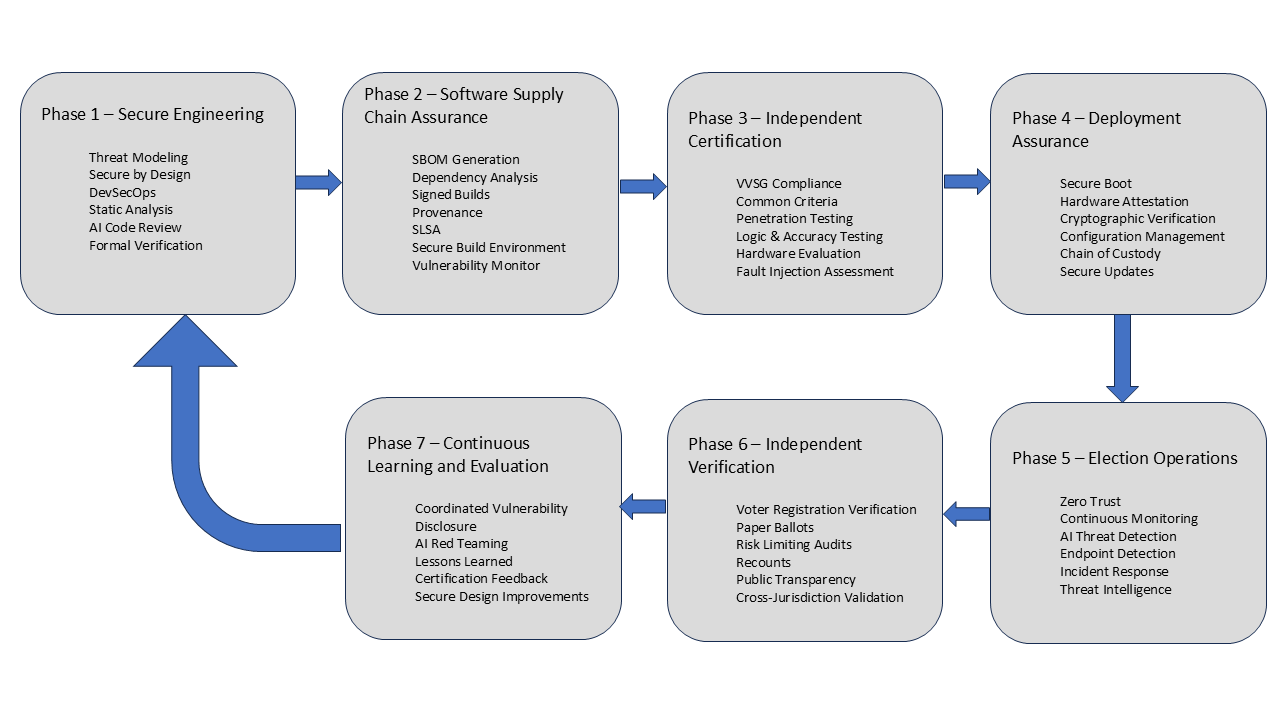
The pipeline forms a closed assurance loop, ensuring that operational findings continuously improve future system development.
Mapping UEAP to Existing Security Frameworks
One of the principal advantages of the proposed architecture is that it does not replace existing standards. Instead, it provides an integration layer that aligns established cybersecurity, software assurance, and election security frameworks across the lifecycle.
| UEAP Phase | Existing Frameworks |
| Secure Engineering | NIST Secure Software Development Framework (SSDF), CISA Secure by Design, OWASP SAMM, Microsoft SDL |
| Supply Chain Assurance | SLSA, SBOM (NTIA/CISA), in-toto, Sigstore, SPDX, CycloneDX |
| Certification | VVSG 2.0, Common Criteria, FIPS 140-3, NIST 800-53, EAC Certification Program |
| Deployment Assurance | TPM, Secure Boot, DICE, Hardware Attestation, Zero Trust Architecture (NIST 800-207) |
| Election Operations | NIST Cybersecurity Framework 2.0, CISA Election Security Guidance, CIS Controls |
| Independent Verification | Risk Limiting Audits, Voter Verifiable Paper Audit Trail (VVPAT), Post-Election Audits |
| Continuous Learning | MITRE ATT&CK, DISARM Framework, CVE, CISA KEV, Coordinated Vulnerability Disclosure |
This mapping illustrates that UEAP functions as an orchestration framework rather than a competing standard. It enables existing practices to operate cohesively as part of a continuous assurance ecosystem.
Election Assurance Maturity Model (EAMM)
Inspired by capability maturity models in software engineering and cybersecurity, the Election Assurance Maturity Model (EAMM) provides a roadmap for jurisdictions to progressively enhance their assurance capabilities.
Level 1 – Certified Systems
Characteristics
- Periodic certification
- Static testing
- Paper documentation
- Manual updates
Primary Question – “Was the system secure when it was certified?”
Level 2 – Managed Security
Characteristics
- Patch management
- Vulnerability scanning
- Chain of custody
- Multi-factor authentication
- Risk-limiting audits
Primary Question – “Is the system operationally secure?”
Level 3 – Supply Chain Assurance
Characteristics
- Software Bills of Materials
- Signed firmware
- Hardware provenance
- Continuous dependency monitoring
- Secure software pipelines
Primary Question – “Can every software component be trusted?”
Level 4 – Continuous Assurance
Characteristics
- Continuous monitoring
- AI-assisted vulnerability discovery
- Automated compliance
- Hardware attestation
- Continuous certification
Primary Question – “Can system integrity be continuously demonstrated?”
Level 5 – Adaptive Democratic Resilience
Characteristics
- AI-assisted cyber defense
- AI-assisted disinformation detection
- Real-time provenance
- Predictive threat modeling
- Automated assurance dashboards
- Continuous public transparency
- Cross-jurisdiction collaboration
Primary Question – “Can the election remain trustworthy despite active attack?”
Unlike conventional maturity models that emphasize technical capability, the EAMM culminates in democratic resilience, recognizing that public confidence is the ultimate security objective.
The Assurance Continuum – Beyond Cybersecurity, Toward a Unified Theory of Assurance
Cybersecurity has traditionally been organized into specialized disciplines including software assurance, hardware assurance, network security, supply chain security, operational security, and information assurance. While each discipline addresses a distinct class of threats, modern critical infrastructure increasingly depends upon their collective effectiveness rather than the strength of any individual control.
Election infrastructure exemplifies this convergence. A successful election depends simultaneously upon trusted software, authentic hardware, resilient operations, secure supply chains, reliable information flows, and public confidence. Weakness in any one of these dimensions can undermine the legitimacy of the entire system, even if all others remain secure.
Accordingly, I propose the Assurance Continuum, a conceptual framework that views assurance as a continuous chain of evidence extending from software creation through democratic legitimacy. Rather than treating trust as a property of a single technology or certification event, the Assurance Continuum considers trust to be an emergent property produced through multiple, interdependent assurance domains.
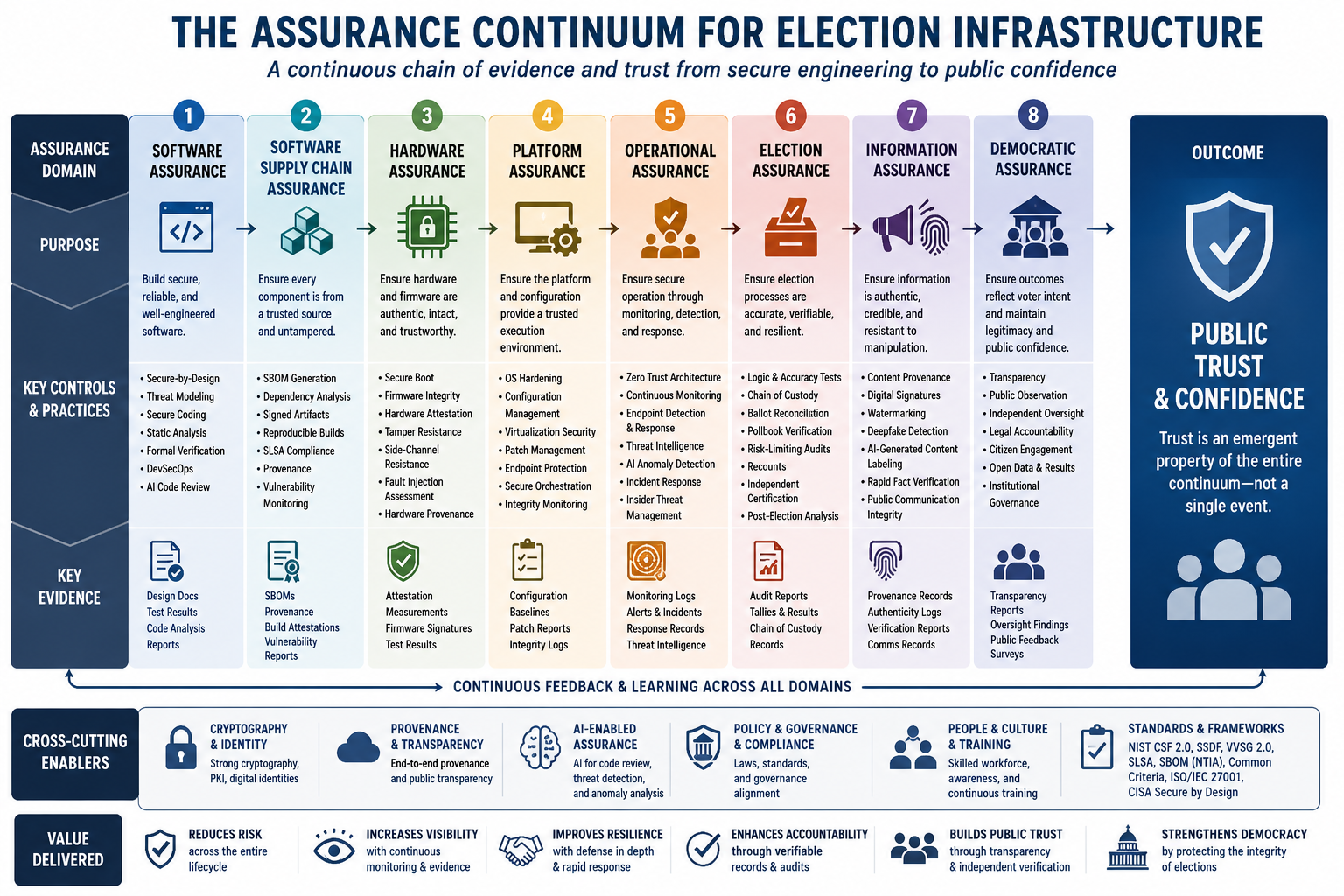
Unlike conventional security models, the continuum recognizes that assurance is cumulative rather than isolated. Confidence in election outcomes emerges from evidence accumulated across every stage of the lifecycle.
Software Assurance
The continuum begins during system engineering.
Secure software development establishes the initial evidence upon which subsequent assurance depends. Secure coding practices, formal verification, threat modeling, secure architecture, static analysis, DevSecOps, and continuous testing collectively reduce the probability that exploitable vulnerabilities are introduced during development.
This layer corresponds closely with the NIST Secure Software Development Framework (SSDF), Secure by Design principles, and modern DevSecOps practices.
Without trustworthy software, no higher assurance layer can compensate for foundational implementation flaws.
Software Supply Chain Assurance
Modern election systems incorporate thousands of third-party software components obtained from commercial vendors and open-source ecosystems. Supply chain assurance extends software assurance by ensuring that every dependency possesses verifiable provenance throughout its lifecycle.
Representative technologies include:
- Software Bills of Materials (SBOMs)
- Supply-chain Levels for Software Artifacts (SLSA)
- reproducible builds
- signed software artifacts
- dependency monitoring
- cryptographic provenance
- secure build environments.
The objective is to answer a simple but increasingly important question: Can every software component executing during an election be traced to a trusted origin?
Hardware Assurance
Software ultimately executes upon physical hardware.
Hardware assurance therefore establishes confidence in processors, firmware, boot ROMs, trusted platform modules, cryptographic accelerators, and other foundational computing components.
Recent advances in fault injection research—including the publicly reproducible Xbox One boot-ROM exploit—illustrate that hardware roots of trust should not be considered immutable. Rather than invalidating hardware assurance, such research reinforces the need for layered verification that combines secure hardware with procedural controls, independent audits, and cryptographic validation.
Hardware assurance should therefore encompass:
- secure boot
- firmware integrity
- hardware attestation
- tamper resistance
- side-channel resistance
- fault-injection assessment
- hardware provenance.
Platform Assurance
Platform assurance integrates hardware and software into operational computing environments.
It encompasses:
- operating systems
- virtualization
- container platforms
- endpoint protection
- configuration management
- secure orchestration
- patch management.
Platform assurance ensures that trusted software continues executing upon trusted hardware within trusted operational environments.
Operational Assurance
Operational assurance addresses the reality that secure systems may still be compromised through misconfiguration, insider threats, credential theft, or operational failures.
Representative mechanisms include:
- Zero Trust
- continuous monitoring
- endpoint detection and response
- security operations centers
- threat intelligence – including foreign influences
- incident response
- insider threat detection
- AI-assisted anomaly detection.
Operational assurance continuously evaluates whether deployed systems remain trustworthy throughout their operational lifetime.
Election Assurance
Election assurance extends operational assurance into election-specific processes.
Examples include:
- voter registration accuracy verification and validation [including controls that are proposed by the SAVE Act]
- logic and accuracy testing
- chain of custody
- ballot reconciliation
- pollbook verification
- risk-limiting audits
- recount procedures
- independent certification
- post-election forensic analysis
Election assurance differs from traditional cybersecurity because it incorporates procedural and legal evidence alongside technical controls.
Information Assurance
Modern elections are increasingly influenced by synthetic media, AI-generated content, coordinated influence campaigns, and misinformation. Consequently, information integrity has become inseparable from technical security.
Information assurance includes:
- provenance
- digital signatures
- watermarking
- deepfake detection
- content authentication
- AI-generated content labeling
- rapid fact verification
- coordinated public communication
The objective is not censorship but preserving confidence in authentic information.
Democratic Assurance
The highest layer of the continuum is democratic assurance. Democratic assurance represents society’s confidence that election outcomes accurately reflect voter intent. Unlike lower layers, democratic assurance cannot be produced solely through technology.
It emerges through:
- transparency
- independent observation
- public audits
- legal oversight
- institutional accountability
- verifiable evidence
- citizen participation.
Democratic legitimacy therefore becomes the ultimate assurance objective rather than a by-product of technical security.
Relationship to the Unified Election Assurance Pipeline
The Assurance Continuum provides the conceptual foundation for the Unified Election Assurance Pipeline as proposed in this article.
Whereas the Continuum defines what forms of assurance are required across the lifecycle, the UEAP defines how those assurance activities are integrated operationally.
The relationship may be summarized as follows:
| Assurance Continuum | Unified Election Assurance Pipeline |
| Conceptual theory | Operational architecture |
| Defines assurance domains | Defines lifecycle activities |
| Explains trust relationships | Implements trust generation |
| Technology agnostic | Election specific |
| Strategic | Operational |
| Long-term evolution | Day-to-day implementation |
Together, the two frameworks establish a comprehensive architecture for continuously assuring election infrastructure from initial software development through public certification of election results.
Extending the Election Assurance Maturity Model
The Election Assurance Maturity Model can now be expanded so that each maturity level maps directly to the Assurance Continuum:
| Maturity Level | Highest Assurance Domain Achieved |
| Level 1 – Certified Systems | Software Assurance |
| Level 2 – Managed Security | Operational Assurance |
| Level 3 – Supply Chain Assurance | Supply Chain + Hardware Assurance |
| Level 4 – Continuous Assurance | Platform + Operational + Election Assurance |
| Level 5 – Adaptive Democratic Resilience | Information + Democratic Assurance |
This mapping demonstrates that maturity is not merely the accumulation of technical controls but the progressive expansion of evidence supporting public confidence.
Conclusion
Election infrastructure has matured significantly over the past decade through improvements in operational procedures, physical security, voter-verifiable paper records, and coordinated cyber defense. Nevertheless, advances in artificial intelligence, increasingly complex software supply chains, and evolving hardware exploitation techniques challenge many of the assumptions underlying traditional certification models.
This article has argued that the future of election security lies not in building invulnerable voting machines but in creating continuously assured election ecosystems. The proposed Unified Election Assurance Pipeline reframes election security as a lifecycle spanning secure engineering, supply chain integrity, operational resilience and transparency, independent verification, and continuous learning and evaluation. Within this framework, hardware trust anchors remain valuable but are complemented by cryptographic provenance, software assurance, operational transparency, and voter-verifiable audit mechanisms.
The Xbox One boot-ROM exploit serves as a cautionary illustration that even sophisticated hardware protections may eventually be overcome by advances in offensive research. Rather than diminishing confidence in election systems, this insight reinforces the importance of layered assurance and independently verifiable processes. In an era where cyberattacks and disinformation seek to erode democratic legitimacy, resilient election infrastructure must be designed not merely to resist compromise but to demonstrate integrity continuously, transparently, and convincingly.
Research Contributions
This article makes four principal contributions.
First, it introduces the Assurance Continuum, a generalized conceptual framework that unifies software assurance, software supply chain assurance, hardware assurance, platform assurance, operational assurance, information assurance, and democratic assurance into a continuous evidence-based model of trust.
Second, it proposes the Unified Election Assurance Pipeline (UEAP), an architectural implementation of the Assurance Continuum for election infrastructure. The UEAP integrates secure engineering, supply chain assurance, certification, deployment, operations, independent verification, and continuous learning into a closed lifecycle.
Third, it introduces the Election Assurance Maturity Model (EAMM), providing a structured roadmap for evolving from static certification toward adaptive, continuously assured election ecosystems.
Finally, the article demonstrates how advances in AI-assisted vulnerability discovery and hardware exploitation—illustrated conceptually through the Xbox One boot-ROM fault-injection research—challenge longstanding assumptions regarding hardware roots of trust and reinforce the need for layered, continuously verified assurance architectures rather than reliance on any single trust anchor.
Future Research Directions
Several research challenges emerge from the proposed framework:
- AI-assisted certification and vulnerability assessment.
- Formal assurance metrics for election software supply chains.
- Integration of hardware attestation with post-election auditing.
- Provenance frameworks for election software artifacts.
- Continuous certification models for long-lived election systems.
- AI-supported risk-limiting audit optimization.
- Cross-jurisdictional assurance and interoperability standards.
Let me know what you think of the Assurance Continuum. How do you instill public confidence through assurance? What can you do about creating trusted and continuously assured infrastructure? Give me your views. And thanks to my subscribers and visitors to my site for checking out ActiveCyber.net! Please give us your feedback because we’d love to know some topics you’d like to hear about in the area of active cyber defenses, artificial intelligence, authenticity, quantum cryptography, risk assessment and modeling, autonomous security, digital forensics, securing OT / IIoT and IoT systems, Augmented Reality, or other emerging technology topics. Also, email chrisdaly@activecyber.net if you’re interested in interviewing or advertising with us at Active Cyber™.



