
August 28, 2026
I was reading through some of the recent DEF CON 34 presentation descriptions and was struck by how complex the deception and evasion techniques have become for malware Command and Control systems (C2). This made me research some more and I discovered that the physical stealth world has also been undergoing a transformation as well – not just aircraft but drones, ships, subs, spacecraft and more. I could see many analogies between physical and cyber stealth and a progression towards a convergence on the future battlefield. So read more below about how stealth is changing the battlefield or listen to my podcast here – or both.
Stealth has traditionally been understood as a physical engineering problem: reduce the observable signatures of an aircraft, ship, vehicle, weapon, or individual so that an adversary’s sensors cannot reliably detect, identify, track, or target it. Radar-cross-section reduction, infrared suppression, acoustic management, electromagnetic control, camouflage, radar-absorbent materials, thermal management, and increasingly sophisticated metamaterials have transformed physical stealth from simple concealment into a multidisciplinary science of observability management.
Cyber operations have produced a parallel but fundamentally different form of stealth. Cyber stealth seeks to conceal systems, identities, communications, processes, infrastructure, and behavior from intrusion-detection systems, endpoint sensors, network monitors, security information and event management platforms, behavioral analytics, and human analysts. The central objective is not necessarily to make a digital entity invisible, but to make it sufficiently difficult to discover, characterize, attribute, or interpret that the adversary cannot respond effectively.
This article presents a comparative framework for understanding these two forms of stealth. It examines the common principle of reducing observability; the different physical and informational constraints governing each domain; multispectral physical stealth and multidimensional cyber stealth; camouflage and behavioral mimicry; passive versus interactive concealment; adaptive and intelligent stealth; and the convergence of cyber and physical stealth in networked autonomous systems. The central argument proposes that stealth is evolving through three conceptual stages: physical concealment, digital concealment, and cognitive concealment. The final stage is particularly significant because it moves beyond defeating sensors toward influencing how sensor outputs are interpreted.
This article argues that future military stealth cannot be evaluated solely at the platform level. In an increasingly networked battlespace, a physically stealthy platform may nevertheless be operationally exposed through its communications, identity, behavior, control architecture, electromagnetic emissions, or data relationships. The relevant unit of stealth is therefore increasingly the digital-physical system of systems. The future of stealth is consequently less about disappearing from an adversary’s sensors than about controlling what the adversary can observe, infer, correlate, and understand.
Introduction
Stealth is often associated with invisibility. In practice, however, neither physical nor cyber stealth generally provides literal invisibility. The more useful definition is operational: stealth reduces the probability that an adversary can detect, identify, track, characterize, attribute, and ultimately exploit a target.
This distinction is fundamental.
A stealth aircraft does not cease to interact with the physical environment. It continues to reflect electromagnetic energy, emit heat, generate sound, produce exhaust, interact with atmospheric conditions, and occupy physical space. What changes is the magnitude, direction, timing, or character of the signatures available to an adversary. Radar stealth, for example, seeks to reduce radar cross section (RCS), thereby decreasing the amount of electromagnetic energy returned to the radar receiver. The operational objective is not necessarily to make the aircraft undetectable under every circumstance, but to reduce detection range, increase uncertainty, complicate tracking, and make the generation of a reliable targeting solution more difficult. Stealth means making detection sufficiently difficult, late, uncertain, or inaccurate that the adversary cannot effectively act.
Cyber stealth operates according to a similar logic, but its signatures are informational rather than primarily physical. A network, device, user, process, malware implant, communication channel, or adversarial actor may be visible in some sense while remaining difficult to recognize as malicious or difficult to associate with a larger campaign. Cyber stealth therefore concerns network signatures, identities, ports, processes, packet characteristics, authentication behavior, traffic patterns, timing, system relationships, and other forms of digital evidence.
This creates a useful conceptual equivalence: Physical stealth hides an object from sensors; cyber stealth hides an entity from detection systems.
The distinction becomes increasingly important as military platforms become dependent upon digital networks. A modern stealth aircraft or unmanned aerial system may possess low radar observability while simultaneously transmitting information, receiving commands, navigating autonomously, updating software, interacting with other platforms, and participating in a distributed sensor network. Consequently, its physical signature is only one component of its total observability.
I propose a broader concept of digital low observability, in which a future combat system must minimize not merely radar, infrared, acoustic, and electromagnetic signatures, but also network and behavioral signatures.
This article develops that proposition and argues that cyber and physical stealth are best understood not as separate technological categories but as increasingly interconnected dimensions of observability management.
The Conceptual Foundation: Stealth as Observability Management
The fundamental commonality between cyber and physical stealth is the reduction or manipulation of observable signatures.
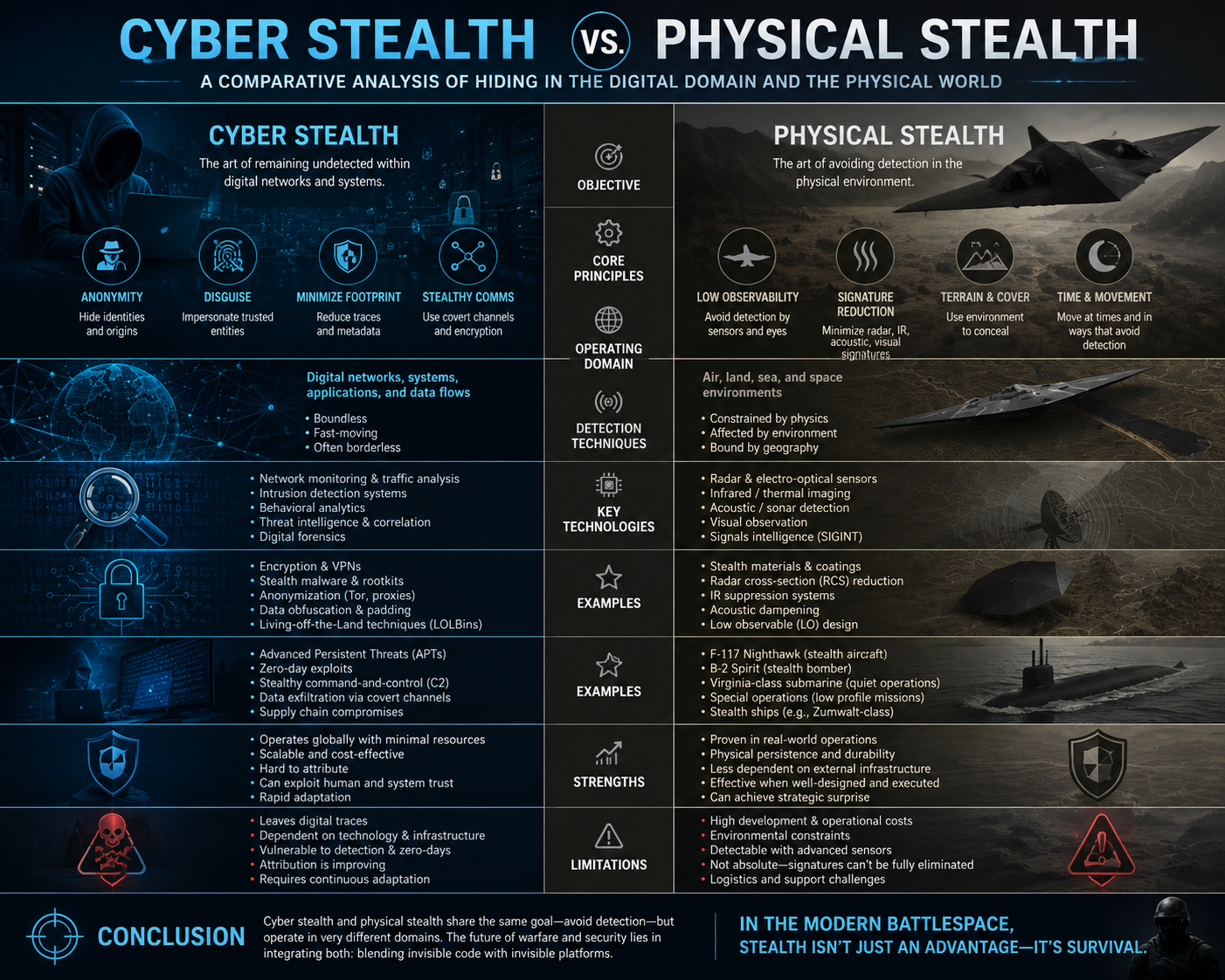
In physical warfare, the concealed object may be an aircraft, ship, vehicle, weapon, soldier, or installation. The adversary employs radar, infrared sensors, electro-optical systems, acoustic sensors, electronic intelligence, thermal imaging, or other sensing technologies. You can summarize the resulting relationship as follows: physical stealth seeks to reduce radar cross section, heat, noise, visual signatures, and RF emissions. Cyber stealth, by contrast, seeks to manipulate IP addresses, ports, processes, packet patterns, login behavior, and traffic patterns.
The comparison can be expressed as follows:
| Dimension | Physical stealth | Cyber stealth |
| Concealed object | Aircraft, ships, vehicles, weapons, personnel | Networks, devices, identities, processes, communications, malware, activities |
| Primary sensors | Radar, infrared, optical, acoustic, RF | IDS/IPS, EDR/XDR, SIEM, network monitoring, behavioral analytics |
| Primary signature | RCS, heat, noise, visual and RF emissions | IP address, port, process, packet pattern, login behavior, traffic pattern |
| Core strategy | Reduce or manipulate physical signatures | Reduce or manipulate digital signatures |
| Typical methods | Shaping, RAM, thermal management, camouflage, electromagnetic control | Encryption, cloaking, obfuscation, traffic masking, identity management, tunneling |
| Mobility | Constrained by physics and platform design | Highly dynamic; routes, identities and behaviors may change rapidly |
| Detection problem | Find and track an object with reduced signatures | Distinguish malicious behavior from legitimate activity |
| Principal countermeasure | Multispectral sensing and sensor fusion | Behavioral analytics, anomaly detection, threat hunting and AI |
| Failure | Detection and tracking | Detection, attribution, containment or forensic discovery |
The table reveals an important difference. Physical stealth primarily modifies what the object physically presents to the sensor. Cyber stealth can modify both what the system presents and how the system behaves.
That second characteristic gives cyber stealth a potentially more dynamic quality.
A physical platform is constrained by its geometry, materials, propulsion system, thermal characteristics, mass, aerodynamic requirements, and electromagnetic properties. A digital system can potentially alter its identity, route, communication method, timing, process relationships, and other observable characteristics in software.
The distinction is therefore not simply physical versus digital. It is increasingly static versus dynamic observability.
Physical Stealth: A Battle Against Physics
Physical stealth begins with an unavoidable constraint: physical objects cannot completely escape the laws governing energy and wave propagation.
An aircraft must reflect, absorb, transmit, or scatter electromagnetic radiation. Its engines generate heat. Its movement produces acoustic effects. Its surfaces interact with visible light. Its communications and sensors may generate electromagnetic emissions.
The problem is consequently one of signature management.
Radar Cross Section
Radar stealth represents one of the clearest examples. Radar transmits electromagnetic energy and analyzes returned signals. Aircraft designers therefore seek to minimize the amount and character of energy returned to the radar receiver.
Geometric shaping can redirect reflected energy away from the receiver. Radar-absorbent materials can reduce reflection by absorbing electromagnetic energy. Edge alignment, inlet treatment, surface continuity, antenna design, and other engineering choices can further reduce the platform’s radar signature.
But RCS reduction is not synonymous with invisibility.
A reduction in RCS can decrease detection range and complicate the production of a sufficiently accurate track or targeting solution. Therefore, it is emphasized that the operational significance of stealth is therefore not simply whether a sensor can detect an object, but whether the sensor can detect and characterize it sufficiently well to support effective action.
This distinction provides an important bridge to cyber operations.
A cyber defender may technically detect anomalous traffic but still lack sufficient information to determine whether the traffic represents malicious activity, what system generated it, who controls it, or what objective it serves. Detection alone is therefore insufficient in both environments.
Multispectral Stealth
A platform optimized against one sensor is vulnerable to another.
An aircraft with a reduced radar signature may still be visible in infrared. A platform with reduced infrared emissions may still generate acoustic or electromagnetic signatures. A vehicle that blends visually into its environment may nonetheless be detected by radar or thermal imaging.
Thus, research and development today focuses on multispectral stealth. Radar, infrared, visual, acoustic, electromagnetic, and thermal signatures must be considered collectively. This creates the need for sensor fusion.
The adversary does not have to defeat every stealth technology independently. It can instead correlate multiple weak signatures. A faint infrared signature, a weak radar return, a transient RF emission, and an unusual acoustic pattern may collectively provide stronger evidence than any individual sensor could generate.
The technological competition consequently becomes: stealth → multispectral sensing → sensor fusion → adaptive stealth.
This same cycle appears in cyberspace.
Metamaterials and the Search for the Adaptive Physical Cloak
Metamaterials and physical cloaking are important extensions of traditional stealth because metamaterials attempt not merely to absorb or reduce a signature but to manipulate the propagation of electromagnetic, optical, acoustic, thermal, or other physical phenomena.
Metamaterial cloaking is an active research area. A 2024 review describes approaches involving plasmonic materials, spatially varying structures, non-resonant metamaterials, negative refraction, and other techniques, while also emphasizing a persistent challenge: broadband invisibility remains difficult and experimental prototypes are much less common than theoretical designs.
The broader field has expanded beyond optical cloaking. Research has investigated metamaterial approaches to optical, acoustic, elastic, thermal, electromagnetic, magnetic, mass-transport, and hydrodynamic cloaking. This is significant because it reveals that physical stealth itself is moving toward a multidomain model.
Traditional stealth might have focused primarily on radar. Next-generation stealth must potentially consider:
- radar;
- infrared;
- visible light;
- acoustic energy;
- thermal gradients;
- electromagnetic emissions;
- magnetic fields;
- and other observable physical phenomena.
The underlying objective remains unchanged: manipulate the environment so that the concealed object becomes less distinguishable from its surroundings.
There are several concepts associated with these efforts, including negative-index materials, zero-index materials, artificial magnetic conductors, plasmonic media, topological structures, thermal cloaks, and metasurfaces.
The broader research literature reinforces the importance of bandwidth. For example, recent metamaterial absorber research has demonstrated designs aimed at broadband radar absorption, while other work has explored flexible, ultrawideband structures combining radar stealth with visible-light transparency.
The practical significance is clear: the future of physical stealth is unlikely to be one material or one coating. It is more likely to involve integrated systems capable of manipulating several signatures simultaneously.
Plasma Stealth: From Fixed Signature Reduction to Tunable Signature Management
Plasma-based stealth represents an especially useful case for comparison because it illustrates the movement from static to adaptive physical stealth.
Plasma stealth is an experimental technique in which an ionized layer surrounding an object modifies the interaction between electromagnetic radiation and the platform. Depending upon plasma characteristics and incident frequency, electromagnetic energy may be reflected, transmitted, scattered, absorbed, or subject to interference effects.
The attraction is adaptability.
Traditional geometric stealth is largely fixed after the platform is manufactured. A shape optimized for one set of radar characteristics cannot be dynamically redesigned during flight. Plasma, theoretically, could be varied by altering properties such as density or temperature.
This creates a potential advantage against frequency-agile radar because the plasma parameters could theoretically be adjusted to respond to changing radar conditions. At the same time, there are substantial engineering barriers: power requirements, stability, heat management, electromagnetic emissions from the plasma itself, visible glow, ionized trails, and the difficulty of creating an effective plasma layer around an entire high-speed aircraft.
This is an important example of a recurring principle: Adaptive stealth is more powerful than static stealth in theory, but adaptive stealth also introduces new observable behaviors and engineering costs.
The same paradox exists in cyberspace.
A cyber system capable of dynamically changing identities, communication methods, routes, and behavior may be more difficult to detect. Yet the very act of changing these characteristics can itself become anomalous.
Adaptability is therefore simultaneously a stealth capability and a potential signature.
Cyber Stealth: The Digital Equivalent of Low Observability
Cyber stealth extends the physical stealth concept into an informational environment. Cyber stealth may be defined as concealing the identity, activity, or presence of systems, users, or threats so that they become harder to detect, monitor, or trace.
This encompasses considerably more than encryption.
Encryption protects the contents of communication, but encrypted traffic can remain observable as traffic. Therefore, encryption is distinguished from broader cyber stealth: network cloaking, traffic masking, identity management, tunneling, endpoint obfuscation, and other mechanisms can attempt to conceal the existence, origin, destination, or infrastructure supporting communication.
This distinction is crucial.
Consider two communications:
- An adversary knows that two systems are communicating but cannot read the message.
- An adversary cannot easily determine that the systems exist, cannot identify their relationship, cannot determine their communication paths, and cannot characterize the traffic.
The first is confidentiality. The second approaches low observability.
Cyber stealth therefore concerns not only what information is protected, but what information about the information system is exposed.
Network Cloaking and the Shrinking of the Attack Surface
One method of creating low observability is through network cloaking. Network cloaking is a means of making devices and services difficult for unauthorized users to discover. There are various approaches to network cloaking – approaches that suppress responses to reconnaissance activities, dynamically alter identities and routes, close externally visible ports, use identity-based access controls, and hide application origin infrastructure.
The following technologies provide examples of cloaking and stealth defensive techniques:
- Solutions like CSOI®operate at Layer 3.5 of the OSI model, using cryptographic device identities and a Layer 3.5 overlay to prevent ping responses, port scans, and SNMP queries from reaching unauthorized systems. This aligns with Zero Trust by allowing only authenticated, authorized traffic.
- Meanwhile, stealth networking techniques, such as those from Dispersive, fragment and encrypt data, send it across multiple dynamic paths, and mask IP addresses and device identifiers with rotating virtual identities. This makes intercepted traffic meaningless and prevents attackers from mapping your network.
- Tools like SSHepherd close all listening ports to the outside world while maintaining secure tunnels for trusted internal traffic. This ensures no visible entry points for scanners, even between trusted systems.
- Secfense Ghost uses dynamic identity-based firewall rules so that only pre-authorized entities can communicate. Unauthorized attempts result in a complete timeout, not an “access denied” message. This is especially effective against zero-day VPN exploits.
- For services and APIs, application cloaking hides origin IPs and prevents attackers from mapping your attack surface. This stops reconnaissance before it can lead to DDoS or targeted attacks.
- StealthMesh is a stealth-enabled, decentralized cyber defense framework tailored for Micro, Small, and Medium Enterprises (MSMEs). The system integrates advanced stealth communication techniques with a decentralized mesh defense protocol to provide affordable, lightweight, and adaptive protection against sophisticated cyber threats. Key features include:
-
- Polymorphic Encryption– Rotating cipher algorithms to prevent pattern analysis
- Decoy Routing– Dynamic path selection with fake traffic injection
- Mesh Network Defense– Peer alerts, consensus voting, coordinated response
- ML-Based Threat Detection– Real-time attack classification (99.63% accuracy)
- Micro-Containment– Autonomous breach isolation and quarantine
- Adaptive MTD– Moving Target Defense with dynamic port/service mutation
The result of these technology capabilities is not literal invisibility. It is reduced attack-surface observability.
These concepts align with the broader Zero Trust security model. NIST’s Zero Trust Architecture emphasizes that organizations should not grant implicit trust based on network location or asset ownership. Instead, authentication and authorization are treated as distinct functions that precede access to resources.
This has an important stealth implication.
Traditional network defense often assumes that an internal network is a relatively trusted environment. Once an adversary crosses the perimeter, considerable information about the network may become accessible. Zero Trust reverses the assumption: resources should be protected individually, access should be explicitly authorized, and trust should not automatically follow network location. NIST’s implementation guidance further emphasizes identity architecture, micro-segmentation, continuous inspection, monitoring, and logging.
From a stealth perspective, this is analogous to distributing camouflage throughout the battlespace.
Zero trust captures this idea through three principles:
- deny by default;
- micro-segmentation;
- continuous verification.
Rather than protecting one perimeter, the defender attempts to make the entire infrastructure more difficult to map and exploit.
Multispectral Stealth versus Multidimensional Cyber Stealth
The strongest analytical parallel between the two domains is the relationship between multispectral sensing and multidimensional behavioral analysis.
A physical stealth platform may conceal its radar signature while exposing an infrared signature. Similarly, a cyber actor may conceal an IP address while exposing anomalous authentication behavior.
Some examples of anomalous behavior include:
- unusual login behavior;
- abnormal process relationships;
- unusual data access;
- anomalous timing;
- suspicious DNS activity;
- unusual network connections.
This is the digital equivalent of multispectral detection.
A defender should not ask only: “What does this packet look like?”
The more important question is: “What does this activity look like when correlated with everything else this system is doing?”
That distinction marks the transition from signature-based detection to behavioral detection.
NIST’s longstanding IDPS guidance recognizes multiple detection classes, including network-based, wireless, network behavior analysis, and host-based approaches, alongside complementary security information and event-management technologies.
The evolution therefore mirrors physical sensing: single signature → multiple signatures → correlation → behavioral inference.
Cyber defenders increasingly need the equivalent of a multispectral sensor suite—not necessarily because each individual signal is decisive, but because relationships among signals reveal what isolated observations cannot.
Camouflage: Blending into the Environment
One of the most interesting similarities between physical and cyber stealth concerns camouflage. Traditional camouflage does not necessarily make an object invisible. It attempts to make the object resemble its environment.
A tank painted to resemble vegetation and terrain is not physically absent. It is simply harder to distinguish from its surroundings.
Cyber operations can exploit the same principle.
Attackers use legitimate administrative mechanisms such as PowerShell, Windows Management Instrumentation, Task Scheduler, and Remote Desktop Protocol. Because these tools have legitimate functions, activity involving them may resemble normal administrative activity.
This produces a fundamental conceptual shift: The most effective form of concealment may not be hiding from the environment but becoming indistinguishable from the environment.
The analogy to physical camouflage is powerful.
Physical camouflage asks: “How do I make this platform resemble the landscape?”
Cyber camouflage asks: “How do I make this activity resemble normal enterprise behavior?”
The underlying challenge is classification rather than simple visibility.
This is why behavioral analytics are increasingly important. The defender is not merely looking for a forbidden object; the defender is attempting to determine whether a sequence of otherwise legitimate actions forms an illegitimate pattern.
Physical Stealth Is Usually Passive; Cyber Stealth Can Be Interactive
This represents one of the most important differences between the two domains.
Physical stealth is primarily passive. A stealth aircraft does not normally manipulate the radar operator’s software or rewrite the radar’s interpretation of the returned signal. It attempts to minimize or shape the signal itself.
Cyber environments permit a more interactive form of concealment.
For example, cyber deception systems are capable of hiding real infrastructure, presenting deceptive infrastructure, observing adversary interactions, learning from those interactions, and changing defensive behavior.
This creates the possibility of active camouflage. A defender can potentially manipulate the adversary’s perception rather than simply reduce its own observability.
This has physical analogs. Decoys, false signatures, electronic warfare, and deception have long been part of military operations. But cyberspace permits deception to become deeply integrated with the environment itself.
The distinction is therefore:
Physical stealth: reduce the signal.
Cyber stealth: reduce the signal, manipulate the signal, manipulate the environment, and potentially manipulate the interpretation of the signal.
This makes cyber stealth more closely related to perceptual warfare than conventional physical stealth.
From Signature Manipulation to Behavioral Stealth
It can be argued that cyber stealth may ultimately become more sophisticated than traditional physical stealth because cyber systems can dynamically alter their behavior. It identifies rotating identities, dynamic routing, changing communication methods, polymorphism, traffic obfuscation, behavioral cloaking, adaptive defense, and AI-driven stealth as examples of this evolution.
This deserves particular attention.
A physical aircraft’s fundamental characteristics remain relatively stable. Its geometry, propulsion, materials, mass distribution, thermal properties, and aerodynamic configuration constrain what it can do.
A digital system is potentially much more plastic:
- Its identity can change.
- Its route can change.
- Its communication protocol can change.
- Its timing can change.
- Its workload can change.
- Its relationship with other systems can change.
- Its behavior can potentially be optimized according to what the environment appears to be observing.
This means that cyber stealth can evolve from signature stealth into behavioral stealth.
The system is no longer simply attempting to hide. It is attempting to behave like something the defender expects.
That is a qualitatively different problem.
Cognitive Concealment
The preceding analysis suggests a third form of stealth beyond physical and digital concealment: cognitive concealment.
The idea of cognitive concealment can be captured through a three-stage progression:
- Physical concealment — “Don’t see me.”
- Digital concealment — “Don’t detect me.”
- Cognitive concealment — “Detect me but misunderstand what you’re seeing.”
This distinction may become one of the most important concepts in future battlespaces.
Traditional stealth attacks the sensor. Digital stealth attacks the detection mechanism. Cognitive stealth attacks the interpretation layer.
The emergence of machine-learning-based detection makes this problem especially significant. If an adversary’s detection system classifies activity as benign because the activity has been deliberately shaped to resemble legitimate behavior, the attacker has not merely avoided detection. The attacker has influenced the meaning assigned to the detection.
This suggests a hierarchy: Observability → Detection → Classification → Attribution → Understanding → Decision
Stealth traditionally focused on the first stage. Cyber stealth increasingly operates across the middle stages. Future AI-enabled stealth may operate across the entire chain.
The Adversarial Relationship Between Stealth and Sensor Fusion
The competition between stealth and detection is therefore not a simple technological race. It is an iterative contest.
Physical stealth produces better sensors.
Better sensors produce multispectral fusion.
Multispectral fusion encourages more sophisticated signature management.
In cyberspace, stealth malware and obfuscation encourage behavioral analytics.
Behavioral analytics encourage more sophisticated deception.
Deception encourages AI-assisted detection.
AI-assisted detection encourages adaptive behavioral stealth.
The cycle is structurally similar in both domains. Essentially it gets down to a contest between stealth and sensor fusion. The critical consequence is that the value of any individual stealth technology decreases as the adversary becomes better at correlating information across multiple dimensions.
A platform optimized against radar alone becomes vulnerable to infrared and electronic surveillance.
A cyber actor that hides its IP address may still reveal itself through process relationships, authentication behavior, DNS activity, timing, or data access.
Thus: The future of stealth is not the elimination of signatures; it is the management of signatures across multiple dimensions simultaneously.
Command and Control as the Cyber Equivalent of a Physical Signature
Command-and-control (C2) systems provide another important comparison. Stealth is the name of the game in sustained C2 operations. Some stealth C2 cyber techniques include:
- Blending with Normal Traffic: By using protocol mimicry (e.g., hiding C2 commands within HTTPS or DNS queries) and packet obfuscation techniques, you can blend your communication traffic with legitimate business processes. Tools like DNScat2 and HTTPS-based implants allow attackers to conduct operations without raising red flags.
- SSL/TLS Encryption: Always encrypt C2 traffic using SSL/TLS to prevent interception and analysis. Tools like Cobalt Strike support SSL certificates to cloak your communications as legitimate web traffic. Certificate pinning and domain fronting add extra layers of deception.
- Avoiding Detection by EDR/XDR Systems: Endpoint and extended detection response (EDR/XDR) solutions are adept at spotting suspicious behavior. To counter this, regularly update implants with polymorphic code or load implants into memory-only environments to avoid leaving traces on disk.
C2 cyber adaptability is also key when sustaining long-term access:
- Modular Payloads: Modular payloads allow attackers to load and execute additional components as needed. For instance, you can deliver a lightweight loader that later pulls in more complex tools for specific tasks, minimizing initial detection risk.
- Staged vs. Stageless Payloads: Staged payloads download and execute additional payloads after initial infection, which is useful for avoiding detection during initial access. Stageless payloads contain the entire code base within a single file, reducing external dependencies and making them harder to disrupt.
- Dynamic Implants: Dynamic implants can change their behavior, recompile themselves, or shift to different communication methods based on environmental factors. For example, an implant might use HTTP during business hours and switch to ICMP-based covert channels after-hours to avoid network monitoring.
C2 is the backbone of any advanced offensive cyber security operation. In environments where maintaining persistent access and real-time control over compromised systems is critical, a well-designed C2 infrastructure determines whether your mission succeeds or fails.
C2 illustrates an essential characteristic of digital stealth: the target is not necessarily a single object.
It is an ecosystem of relationships. Those relationships may include:
- endpoints;
- identities;
- communications;
- servers;
- domains;
- processes;
- authentication events;
- timing patterns;
- data flows;
- infrastructure dependencies.
This means that cyber stealth must manage not merely individual signatures but relational signatures.
A platform can be stealthy while its network is not.
A network can be difficult to discover while its behavioral patterns remain conspicuous.
A communication channel can be encrypted while the existence and timing of the communication remain observable.
This relational dimension has no exact physical equivalent, although distributed military operations, electronic warfare, logistics, and communications security provide partial analogs.
The Stealth Drone as the Convergence Point
The most consequential area of convergence is the autonomous or semi-autonomous drone.
A future stealth drone may be described as a system combining:
- low radar observability;
- reduced infrared signature;
- encrypted communications;
- autonomous navigation;
- distributed sensors;
- AI-enabled decision-making.
This list illustrates why the traditional distinction between physical and cyber stealth is becoming increasingly artificial.
Consider an unmanned aircraft with an extremely low RCS. If its communications architecture is easily discovered, the platform may still be vulnerable. If its control architecture can be mapped, the adversary may understand how to disrupt or deceive it. If its network identity is compromised, the adversary may associate otherwise ambiguous signals with the platform. If its behavioral pattern is distinctive, machine-learning systems may identify it even without a conventional signature.
Physical stealth is therefore necessary but insufficient.
The emerging requirement is operational stealth.
Operational stealth encompasses the entire platform ecosystem: physical signature + electromagnetic signature + network signature + behavioral signature + identity signature + relational signature.
This is the essence of digital low observability.
The “Clones and Drones” Battlefield
The digital low observability concept becomes especially important when applied to a future “clones and drones” battlefield.
A battlespace populated by large numbers of autonomous systems changes the economics of detection. An adversary may no longer need to identify every individual platform immediately. Instead, it may use behavioral patterns, network relationships, emissions, movement patterns, and sensor fusion to identify groups or classes of systems.
This creates a new form of battlefield signature.
Imagine a swarm of hundreds of autonomous platforms. Each individual drone may have low observability, but the swarm’s collective behavior could become detectable.
The adversary may identify:
- common movement patterns;
- synchronized communications;
- recurring electromagnetic behavior;
- common navigation decisions;
- similar response patterns;
- shared infrastructure;
- common software characteristics.
The result is analogous to physical multispectral detection but at the system-of-systems level. Stealth must therefore migrate from the individual platform to the collective.
This is a profound change. The question is no longer: “Can the enemy see my drone?”
It becomes: “Can the enemy recognize the architecture, behavior, identity, and relationships of my entire force?”
Adaptive Stealth and the Move Toward Intelligent Stealth
Both physical and cyber stealth are moving toward adaptive architectures.
The physical transition is occurring through:
- metamaterials;
- thermal cloaking;
- adaptive materials;
- plasma-based stealth;
- AI-assisted stealth;
- quantum-enabled optimization.
In cyberspace, the corresponding transition includes:
- AI-driven stealth;
- adaptive deception;
- dynamic identities;
- behavioral adaptation;
- AI-based anomaly detection;
- autonomous defense.
The parallel can be represented as: Static stealth → Adaptive stealth → Intelligent stealth
Static stealth relies on predetermined characteristics.
Adaptive stealth responds to the environment.
Intelligent stealth attempts to predict or understand the environment and change accordingly.
This progression has major implications:
A static stealth system can be tested against a known sensor.
An adaptive system must be tested across changing conditions.
An intelligent system must be evaluated against an adversary capable of learning.
The result is an increasingly complex contest between two adaptive systems: stealth AI versus detection AI.
The Fundamental Paradox of Adaptive Stealth
Adaptive stealth introduces an important paradox: Changing behavior may reduce predictability, but excessive change may itself become anomalous.
A physical platform that suddenly changes thermal, electromagnetic, or acoustic characteristics may create a new signature.
A cyber system that changes identities, communication paths, timing, or processes too frequently may create behavioral anomalies.
Therefore, optimal stealth may not mean maximum variability.
It may mean contextually appropriate variability.
The goal becomes not to behave randomly but to behave plausibly. This distinction separates obfuscation from camouflage.
Randomness is often detectable. Plausibility is more difficult.
Consequently, the future of cyber stealth may depend increasingly upon models of normal behavior. The better an adversary understands what “normal” looks like, the more difficult it becomes to construct convincing behavioral camouflage.
This creates another feedback loop: Normality modeling → behavioral camouflage → improved anomaly detection → improved behavioral adaptation.
The Defender’s Dilemma
Stealth technologies impose a difficult burden on defenders. The defender cannot simply search for everything.
Physical sensing produces enormous quantities of data. Cyber environments produce even larger quantities of logs, network flows, authentication events, endpoint telemetry, and application activity.
The challenge therefore becomes one of information discrimination.
The defender must determine which weak signals matter. This is why sensor fusion and behavioral analytics are so important.
In both domains, the defender’s objective becomes: Transform weak, ambiguous observations into sufficiently strong evidence to support action.
AI may become increasingly important because human operators cannot manually correlate every available signal across a large, distributed battlespace. But AI introduces a new vulnerability: classification systems themselves can become targets of deception.
This returns the problem to cognitive concealment.
Toward Cognitive Sensor Fusion
The ultimate evolution of sensor fusion may therefore be cognitive sensor fusion.
Traditional sensor fusion combines multiple observations.
Cognitive fusion interprets relationships among those observations.
For physical stealth, this might involve combining radar, infrared, optical, electronic, acoustic, and behavioral data.
For cyber stealth, it might involve combining identity, process, network, timing, authentication, application, and data-access information.
For future military systems, both could be combined.
A drone’s radar signature could be correlated with:
- its electromagnetic emissions;
- its network identity;
- its communication timing;
- its navigation behavior;
- its interactions with other platforms;
- its data exchanges;
- its command relationships.
The battlespace thus becomes a unified sensing environment. The distinction between “physical intelligence” and “cyber intelligence” begins to erode.
Stealth as a Property of the System of Systems
The most important implication of this analysis is that stealth is becoming a property of systems rather than individual platforms.
The following table expresses the transition explicitly:
| Traditional battlefield | Emerging battlefield |
| Hide the aircraft | Hide the aircraft and its network identity |
| Reduce radar signature | Reduce radar and network signatures |
| Hide from radar | Hide from radar and cyber reconnaissance |
| Protect communications | Make communications difficult to detect and characterize |
| Use camouflage | Use physical and digital camouflage |
| Deploy decoys | Deploy physical and cyber deception |
| Avoid detection | Control what the adversary can perceive |
| Stealth platform | Stealth system-of-systems |
This is more than an incremental technological development. It represents a conceptual transformation.
The aircraft is no longer the unit of stealth. The unit of stealth becomes the operational ecosystem. That ecosystem includes the platform, sensors, communication links, command architecture, software, identities, supporting infrastructure, logistics, operators, autonomous decision systems, and other platforms.
A vulnerability anywhere in that ecosystem can undermine stealth elsewhere.
Implications for Military Doctrine
This convergence should change how military organizations conceptualize survivability.
Traditional platform-centric thinking asks:
- How low is the aircraft’s RCS?
- How effective is its infrared suppression?
- How difficult is it to track?
A system-level approach must additionally ask:
- Can the platform’s communications be detected?
- Can its network identity be mapped?
- Can its behavior be distinguished from other systems?
- Can its autonomous decision patterns reveal its presence?
- Can its supporting infrastructure be identified?
- Can the adversary correlate multiple weak signals?
- Can compromised systems expose otherwise stealthy systems?
- Can cyber and physical signatures be fused?
The result is a new definition of survivability.
Survivability is increasingly a function of the adversary’s total ability to observe, correlate, understand, attribute, and act against the system.
This is broader than conventional low observability.
It is cognitive survivability.
Research Implications
Several research priorities emerge from the comparison.
Multidomain Signature Modeling – Future research should model physical and cyber signatures together rather than separately. A drone’s RCS should be considered alongside its RF emissions, network behavior, navigation patterns, software characteristics, and communication architecture.
Adaptive Physical Materials – Metamaterials and metasurfaces should increasingly be evaluated for their ability to adapt across frequencies and environmental conditions rather than simply achieving peak performance in a narrow band. The literature continues to identify broadband invisibility as a central challenge.
Thermal and Multiphysics Cloaking – Research should continue to integrate electromagnetic, optical, acoustic, and thermal cloaking. Existing literature demonstrates that metamaterials can be designed to influence multiple physical fields.
Behavioral Cyber Stealth – Cyber research should move beyond signature suppression toward models of behavioral plausibility, recognizing that the most difficult activity to detect may be activity that is statistically consistent with legitimate behavior.
AI versus AI – As defenders employ AI to identify anomalies, adversaries will seek to influence AI classification. Future research therefore needs to address adversarial machine learning, explainability, robustness, and deception resistance.
Autonomous System-of-Systems Stealth – The most important future research problem may be the stealth of autonomous groups rather than individual platforms. A swarm that is individually difficult to detect may nevertheless produce collective signatures.
The challenge is therefore to understand emergent observability.
Ethical and Strategic Considerations
The expansion of stealth into cyber and autonomous systems also introduces strategic and ethical concerns.
Physical stealth historically involved engineering a platform to survive within a hostile sensor environment.
Cyber stealth can involve deception, manipulation, concealment, and potentially deliberate influence over an adversary’s decision process.
When AI becomes involved, the distinction between concealment and deception becomes increasingly blurred.
An autonomous system that changes its behavior in response to perceived surveillance raises questions about accountability, control, escalation, and interpretability. Similarly, autonomous cyber defense that deploys deception and adaptive responses raises questions about proportionality and unintended escalation.
There are ethical concerns emerging around autonomous military applications alongside the technological promise of agentic AI, quantum computing, and distributed architectures.
These concerns should be treated as part of the engineering problem rather than as an afterthought.
A New Taxonomy of Stealth
The comparative analysis supports a broader taxonomy.
Level I: Physical Concealment
The goal is to reduce the probability of physical detection.
“Don’t see me.”
Examples include:
- radar cross-section reduction;
- thermal suppression;
- visual camouflage;
- acoustic management;
- electromagnetic signature reduction.
Level II: Digital Concealment
The goal is to prevent discovery, identification, or tracing within digital systems.
“Don’t detect me.”
Examples include:
- network cloaking;
- identity protection;
- traffic masking;
- encryption;
- dynamic routing;
- attack-surface reduction.
Level III: Behavioral Concealment
The system attempts to make its activity resemble legitimate or expected activity.
“Don’t recognize me.”
Examples include:
- behavioral mimicry;
- legitimate-tool abuse;
- adaptive identities;
- dynamic communication;
- contextual activity.
Level IV: Cognitive Concealment
The objective becomes influencing the adversary’s interpretation.
“Detect me but misunderstand what you’re seeing.”
This may involve:
- deception;
- adversarial manipulation;
- false signals;
- deceptive infrastructure;
- AI-targeted perception management;
- adaptive behavior designed to defeat classification.
Level V: System-of-Systems Concealment
The final level concerns the entire operational ecosystem.
“Understand as little of the system as possible.”
At this level, stealth encompasses:
- platform signatures;
- network signatures;
- identity;
- communications;
- behavioral relationships;
- infrastructure;
- autonomous decision-making;
- collective behavior.
This final level is likely to characterize the most advanced future battlespace.
Conclusion
Cyber stealth and physical stealth originate in different technological traditions, but they are converging around a common problem: observability.
Physical stealth reduces what adversary sensors can see, hear, measure, or receive. Cyber stealth reduces what adversary detection systems can discover, classify, attribute, and understand. Both operate within an adversarial cycle in which concealment drives improvements in sensing, and improved sensing drives more sophisticated concealment.
The comparison demonstrates several fundamental similarities.
First, neither form of stealth requires literal invisibility. Operational stealth is about making detection sufficiently difficult, uncertain, delayed, or inaccurate to prevent effective action.
Second, both domains are moving from single-signature concealment toward multidimensional observability management. Physical stealth increasingly requires multispectral management across radar, infrared, optical, acoustic, thermal, and electromagnetic domains. Cyber stealth similarly requires management of network, identity, process, timing, traffic, authentication, and behavioral signatures.
Third, both fields are moving from static to adaptive stealth. Metamaterials, thermal cloaking, plasma concepts, adaptive materials, and AI-assisted physical systems represent the physical side of this evolution. Dynamic identities, adaptive routing, behavioral cloaking, deception, autonomous defense, and AI-driven stealth represent the digital side.
Fourth, cyber stealth introduces an important capability that physical stealth only partially possesses: interactive manipulation of the sensing environment. Cyber deception can potentially influence not only what an adversary observes but how that adversary interprets the observation.
This produces the most important distinction between the two fields.
Physical stealth attempts to defeat the adversary’s sensors. Cyber stealth increasingly attempts to defeat the adversary’s ability to recognize what its sensors are seeing.
The distinction is consequential.
A stealth aircraft effectively says: You probably cannot see me.
Advanced cyber stealth says: You may see me, but you may not realize what you are seeing.
The future of military stealth will likely combine both propositions.
A future autonomous aircraft, drone swarm, or networked combat system will have to minimize radar, infrared, acoustic, thermal, electromagnetic, network, identity, and behavioral signatures simultaneously. Its survivability will depend not only upon how difficult it is to detect, but also upon how difficult it is to characterize, attribute, correlate, and understand.
The ultimate convergence is therefore not simply between cyber technology and physical technology. It is between stealth and cognition. Stealth is becoming a problem of controlling perception.
The decisive question in the future battlespace may consequently no longer be: “Can the adversary see me?”
It may be: “What does the adversary believe it is seeing—and how much of the system can it actually understand?”
That represents the transition from low observability to cognitive concealment, and from the stealth platform to the stealth system-of-systems.
Stealth has become the decisive factor in battlefield success as well as the cyber wars that go on every day. The convergence of physical stealth and cyber stealth along with AI poses unique opportunities and challenges for military tactics and doctrine for the battlefield of the future. Let me know how cyber stealth is changing with autonomous systems and AI. Give me your views. And thanks to my subscribers and visitors to my site for checking out ActiveCyber.net! Please give us your feedback because we’d love to know some topics you’d like to hear about in the area of active cyber defenses, artificial intelligence, authenticity, quantum cryptography, risk assessment and modeling, autonomous security, digital forensics, securing OT / IIoT and IoT systems, Augmented Reality, or other emerging technology topics. Also, email chrisdaly@activecyber.net if you’re interested in interviewing or advertising with us at Active Cyber™.



