
August 16, 2026
For centuries, military advantage has been measured in weapons, manpower, territory, and technological superiority. But the battlefield is changing. As autonomous drones, AI, networked weapons, satellites, robotic vehicles, and increasingly realistic autonomous agents become integrated into military operations, warfare is evolving into something far more complex: a cyber-physical battle for control of information and trust.
The future battlefield may not be defined simply by who has the most powerful weapons. It may be defined by who can determine what is real. Learn more about the future battlefield and how it will change below and listen to the podcast at the link here.
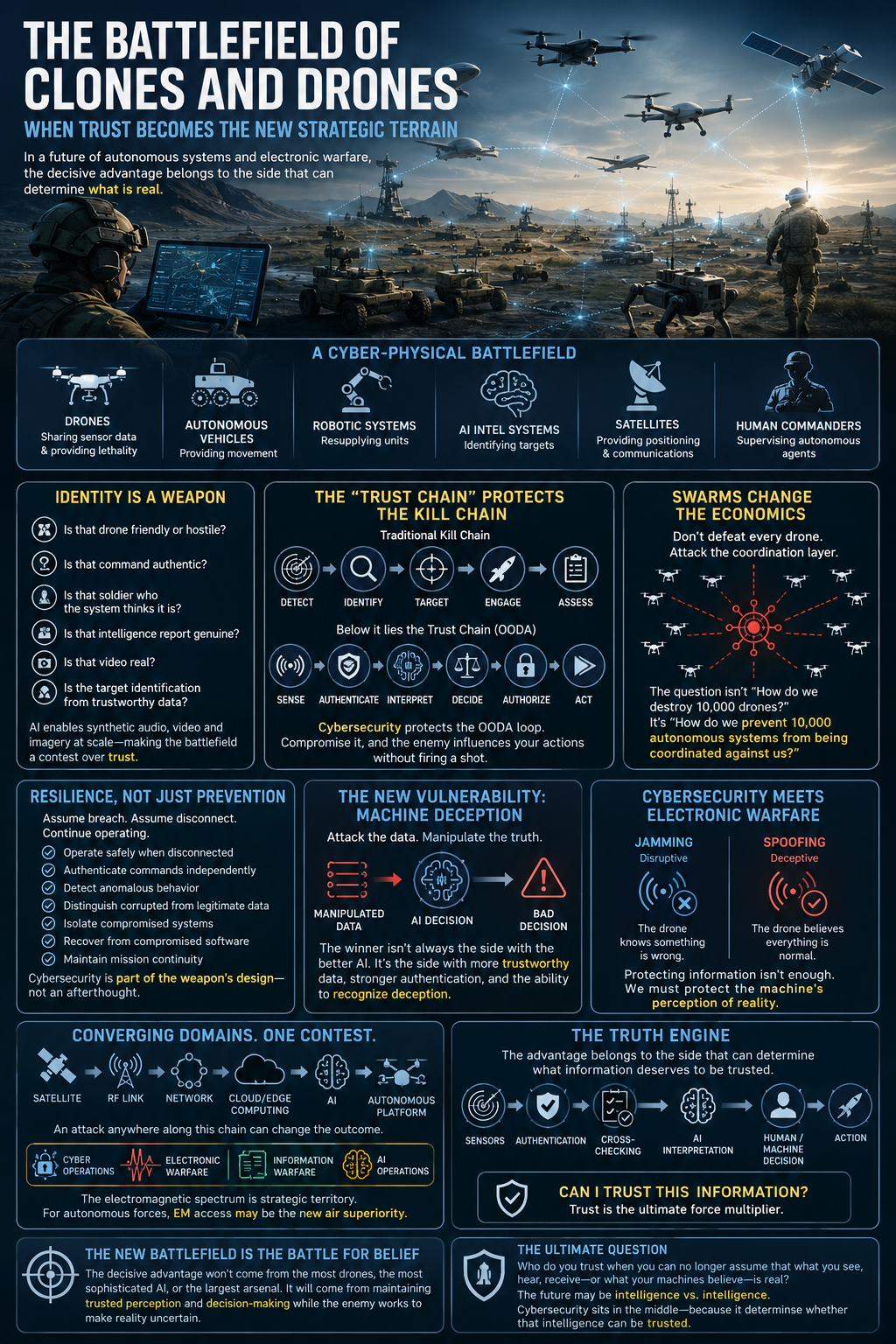
The Battlefield Becomes a Cyber-Physical System
Today’s military platforms are already heavily networked. In a future “clones and drones” environment, thousands of autonomous systems could communicate continuously—drones sharing sensor data, autonomous vehicles providing mobility, robotic systems resupplying units, AI systems identifying targets, satellites providing communications and positioning, and human commanders supervising large numbers of robotic agents.
That creates a radically different attack surface.
A cyberattack does not necessarily have to destroy a drone to be effective. It may be more powerful to change what the drone believes.
A compromised sensor, spoofed GPS signal, manipulated intelligence feed, or corrupted software update could cause an autonomous system to make the wrong decision while appearing to operate normally. That is a profound change in warfare. The objective is no longer simply to disable an enemy platform. It may be to manipulate its perception of reality.
Identity Becomes a Weapon
In a battlefield filled with autonomous systems—or even highly realistic artificial agents—identity becomes critical.
- Is that drone friendly or hostile?
- Is that command authentic?
- Is that soldier actually who the system thinks it is?
- Is that intelligence report genuine?
- Is that video real?
- Is target ID based on trustworthy information?
AI makes these questions harder because synthetic audio, video, imagery, and communications can be generated at enormous scale. The battlefield could therefore become a contest over trust.
This suggests that the traditional military “kill chain” may have a new layer underneath it.
The traditional sequence is:
Detect → Identify → Target → Engage → Assess
But an autonomous battlefield also depends on another sequence – the OODA loop:
Sense → Authenticate → Interpret → Decide → Authorize → Act
Cybersecurity protects this second chain. If an adversary compromises the information moving through it, they may be able to influence the first chain without ever firing a weapon.
The more autonomous the battlefield becomes, the more important cybersecurity—and human trust in machines—becomes.
Swarms Change the Economics of Warfare
The emergence of autonomous swarms could fundamentally change military economics. A single sophisticated weapons platform can be extraordinarily expensive. Thousands of inexpensive autonomous drones represent a different challenge.
The defender may not need to destroy every individual drone. Instead, cyber capabilities could potentially target the coordination layer that allows thousands of systems to operate together. Command-and-control architecture therefore becomes a strategic target.
The question changes from:
How do we destroy 10,000 drones?
to:
How do we prevent 10,000 autonomous systems from being coordinated against us?
And there is a corresponding defensive question:
How do we ensure our own 10,000 systems can continue operating when communications are disrupted?
That second question points toward one of the most important changes in cybersecurity: resilience rather than simple prevention.
Cybersecurity Must Assume the Network Will Fail
A future military cannot assume its networks will remain secure—or even connected. The more realistic objective is a zero-trust approach in a contested environment: Assume breach. Assume disconnect. Continue operating.
Autonomous systems may therefore need to operate safely while disconnected, authenticate commands independently, detect anomalous behavior, distinguish corrupted information from legitimate information, isolate compromised systems, recover from compromised software, and maintain mission continuity when portions of the network fail.
This means cybersecurity cannot remain an IT function added after a weapon has been designed. Cybersecurity becomes part of the weapon itself.
The New Vulnerability: Machine Deception
Humans can be deceived by propaganda. Machines can potentially be deceived through data.
An adversary may not need to attack an AI system directly. Instead, they can manipulate the information upon which the AI makes its decisions. That creates an important paradox:
The side with the better AI isn’t necessarily the winner.
The advantage may belong to the side with the more trustworthy data, more resilient networks, stronger authentication, and better ability to recognize deception.
The future battlefield may therefore become a contest of intelligence versus intelligence, with cybersecurity determining whether that intelligence can be trusted.
When Cybersecurity Meets Electronic Warfare
Electronic warfare adds another dimension to this problem.
Traditionally, cybersecurity has focused on networks, software, credentials, endpoints, and data. Electronic warfare attacks the physical environment surrounding those systems—communications links, radar, GPS/GNSS, radio frequencies, and other electromagnetic-dependent capabilities.
The distinction between cyberattack and electronic attack may therefore become increasingly difficult to maintain.
A cyberattack might manipulate the data. Electronic warfare might prevent the data from arriving—or cause the system to receive something misleading. The result can be identical: The machine makes a bad decision.
Jamming Is Disruptive. Spoofing Is Deceptive.
Consider two different attacks on a drone.
- Jamming: The drone cannot receive its signal.
- Spoofing: The drone receives a false signal and believes it is legitimate.
The second may be far more dangerous.
A drone that loses GPS knows something is wrong. A drone receiving convincing but false positioning information may believe everything is functioning normally. That creates a crucial distinction for future cybersecurity: Availability attacks are disruptive. Integrity attacks can be deceptive.
Protecting information therefore isn’t enough. Military systems must determine whether information is authentic.
Protecting the Machine’s Perception of Reality
This is where electronic warfare and AI intersect.
A human operator may recognize that something does not look right. An autonomous system, however, depends on its sensors and algorithms. If electromagnetic attacks manipulate the information reaching those sensors, an autonomous system could make decisions based upon a false representation of its environment.
The cybersecurity objective consequently expands. It is no longer enough to protect the computer and to make sure information is available, but whether it is authentic as well. We have to protect what the computer believes.
That may be one of the defining cybersecurity challenges of autonomous warfare.
Cyber, EW, AI, and Information Warfare Converge
Modern military systems increasingly form a continuous, operationally-networked chain:
Satellite → RF link → Network → Cloud/Edge Computing → AI → Autonomous Platform
An attack anywhere along that chain can affect the final decision. As a result, cyber operations, electronic warfare, information warfare, and AI operations may increasingly become components of a single contest for control of the information environment.
The electromagnetic spectrum itself becomes strategic territory.
Modern warfare already recognizes land, sea, air, space, and cyberspace as critical domains. For an autonomous military, electromagnetic access could become something resembling air superiority.
If forces cannot communicate, navigate, sense, coordinate, or access trusted information, superior weapons may not matter.
The Rise of the “Truth Engine”
The military advantage of the future may depend less on simply possessing more AI and more on possessing AI that can determine what information deserves to be trusted.
The winning architecture could look something like:
Sensors → Authentication → Cross-checking → AI Interpretation → Human/Machine Decision → Action
At every stage, the same question must be asked: Can I trust this information?
That is a very different conception of military superiority.
The most advanced weapon may not be the one with the greatest destructive capability. It may be the one that can continue making reliable decisions when the enemy is deliberately trying to corrupt its perception.
The New Battlefield Is the Battle for Belief
Put four developments together—electronic warfare, cybersecurity, AI, and autonomous systems—and the nature of warfare begins to change.
- Electronic warfare attacks the information environment.
- Cybersecurity protects its integrity.
- AI interprets the information.
- Autonomous systems act upon the interpretation.
Together, they create a battlefield where controlling perception can be as important as controlling physical terrain. It could become a war over trust.
The ultimate question may no longer be:
Who has the better weapon?
Instead, it may be:
Who can still tell what is real when every machine, signal, image, command, and piece of intelligence could be manipulated?
That question goes to the heart of future military power.
The decisive contest may not simply be human versus human or machine versus machine.
It could become:
Intelligence versus intelligence.
And cybersecurity sits directly in the middle because it determines whether that intelligence can be trusted.
The battlefield of the future may therefore be won not by whoever has the most machines, but by whoever can preserve a trustworthy understanding of reality while the enemy is actively trying to destroy it.
In the age of clones, drones, AI, and electronic warfare, trust may become the new strategic terrain of warfare.
The battlefield of the future is no longer only in the realm of science fiction but increasingly a real phenomenon. Are the “Clone Wars” around the corner? Let me know how cybersecurity for the battlefield is changing with autonomous systems and AI. Give me your views. And thanks to my subscribers and visitors to my site for checking out ActiveCyber.net! Please give us your feedback because we’d love to know some topics you’d like to hear about in the area of active cyber defenses, artificial intelligence, authenticity, quantum cryptography, risk assessment and modeling, autonomous security, digital forensics, securing OT / IIoT and IoT systems, Augmented Reality, or other emerging technology topics. Also, email chrisdaly@activecyber.net if you’re interested in interviewing or advertising with us at Active Cyber™.



